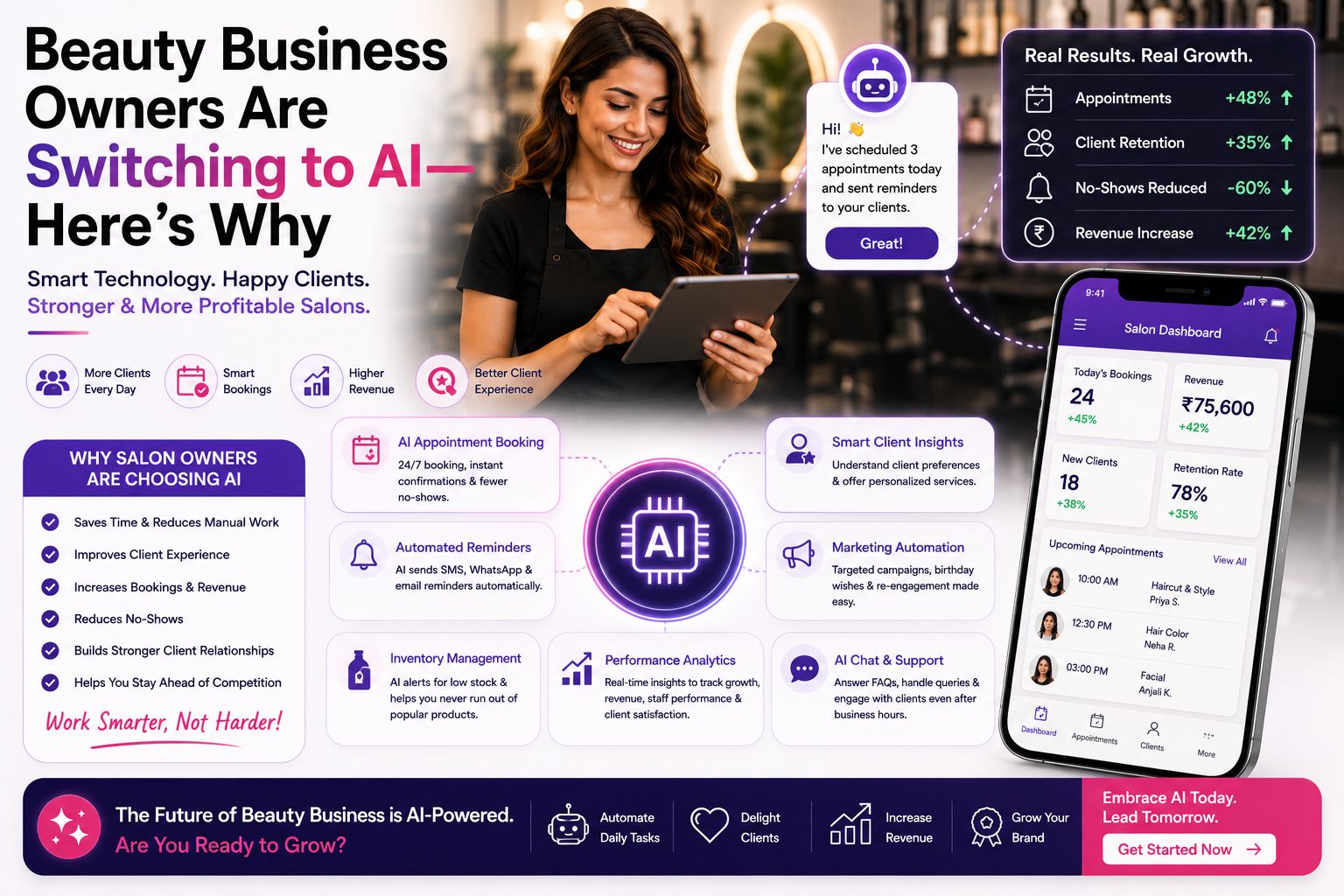
Beauty business owners across India are increasingly turning to AI tools to handle daily operations that once demanded hours of manual effort. The decision to switch often starts with frustration—missed appointments, endless phone calls, and inconsistent client follow-ups. Many salon owners first notice the shift when competitors seem more responsive and organized. This growing trend reflects a practical response to operational pressure rather than a fascination with technology. The core question for many owners remains simple: can AI actually reduce the chaos of running a beauty business? Honestly, sometimes you just wonder if it's another thing that'll add more headache before it helps.
## What the Shift to AI Actually Means for Salon Operations
The move toward AI in beauty businesses is not about replacing human touch or creativity—that's what everyone worries about first. Instead, it addresses repetitive tasks that eat into time better spent on clients. Booking management, reminder messages, inventory tracking, and basic client queries can now be handled through automated systems. Salon owners who have adopted these tools report fewer no-shows and more predictable daily schedules. The confusion many owners face initially involves understanding what AI can and cannot do. Like, will it mess up a client's long-standing preference? Probably not if you set it right. AI works best for structured, repeatable tasks—not for personalized consultations or creative service decisions. However, even limited automation frees up significant mental bandwidth. Owners find themselves less exhausted at the end of the day because fewer small decisions demand their attention. This operational clarity is often the first tangible benefit noticed after switching.
## Why Results Vary Among Beauty Businesses Using AI
Not every beauty business experiences the same benefits from AI adoption. The outcome depends heavily on how well the tool matches the specific workflow of the salon. A small home-based parlour may need simpler scheduling help, while a large salon chain requires multi-location coordination and staff management. AI tools that work for one type of business may feel overwhelming or inadequate for another. Another factor influencing results is staff readiness. If team members resist using new systems, adoption slows and benefits remain limited—and let's be real, getting everyone on board is its own battle. Owners often overlook the importance of training and gradual implementation. The most satisfied salon owners are those who started with one feature—like automated appointment reminders—before expanding to additional functions. Patience during the transition period makes a measurable difference. The variation in outcomes has less to do with the tool itself and more with how thoughtfully it is introduced.
## Common Misconceptions About AI in Beauty Business Management
One widespread misconception is that AI will eventually replace salon staff or reduce the need for human interaction. In reality, AI handles administrative load so that staff can focus on what they do best—providing services and building client relationships. Another misunderstanding involves cost. Many small salon owners assume AI tools are expensive and designed only for large chains. Affordable options exist for businesses of all sizes, and many offer free trials or tiered pricing. Some owners also believe that AI requires technical expertise. Modern beauty business tools are built for non-technical users, with simple interfaces and customer support. A deeper blind spot involves data privacy. Some owners hesitate to store client information in AI systems, fearing misuse—and honestly, that's a valid concern. Reputable tools follow standard data protection practices, but owners should always verify privacy policies before committing. These misconceptions often delay adoption longer than necessary.
## How Beauty Business Owners Can Decide When to Switch to AI
The decision to adopt AI should begin with identifying the most painful operational bottleneck. If missed appointments are the main issue, start with an AI booking and reminder system. If client communication feels overwhelming, try an automated messaging tool. The key is to solve one problem at a time rather than attempting a full system overhaul immediately. Owners should also consider the seasonality of their business. Switching during a slow period allows time for learning and adjustment without compromising client experience. Another useful step is to consult with other salon owners who have already made the switch. Real experiences often reveal practical insights that marketing materials do not cover. Parlourtime discussions frequently highlight that operational relief matters more than advanced features. When evaluating tools, prioritize reliability and ease of use over flashy capabilities. A simple tool used consistently outperforms a complex tool used poorly. The right time to switch is when daily frustration outweighs the effort of learning something new—and trust me, you'll know when that tipping point hits.
q What is the main reason beauty business owners switch to AI?
a The main reason is to reduce the time spent on repetitive tasks like booking management, reminders, and client follow-ups.
q Does AI replace salon staff or reduce the need for human interaction?
a No, AI handles administrative tasks so that staff can focus more on direct client service and relationship building.
q Are AI tools expensive for small beauty businesses?
a Affordable options exist for businesses of all sizes, and many offer free trials or tiered pricing plans.
q Do beauty business owners need technical skills to use AI tools?
a Most modern AI tools for beauty businesses are designed for non-technical users with simple interfaces and support.
q Can AI help reduce no-shows in salons?
a Yes, automated reminder systems significantly reduce no-show rates by sending timely notifications to clients.
q Is AI useful for managing multiple salon locations?
a Yes, many AI systems offer multi-location scheduling and coordination features suited for larger salon chains.
q What is the common mistake owners make when adopting AI?
a A common mistake is trying to implement too many features at once instead of starting with one specific problem.
q How can owners evaluate if an AI tool is right for their business?
a Owners should identify their biggest operational bottleneck and test a tool that solves that specific issue during a slow period.Earn Upto ₹70,000/Month! Become a Parlourtime Partner.