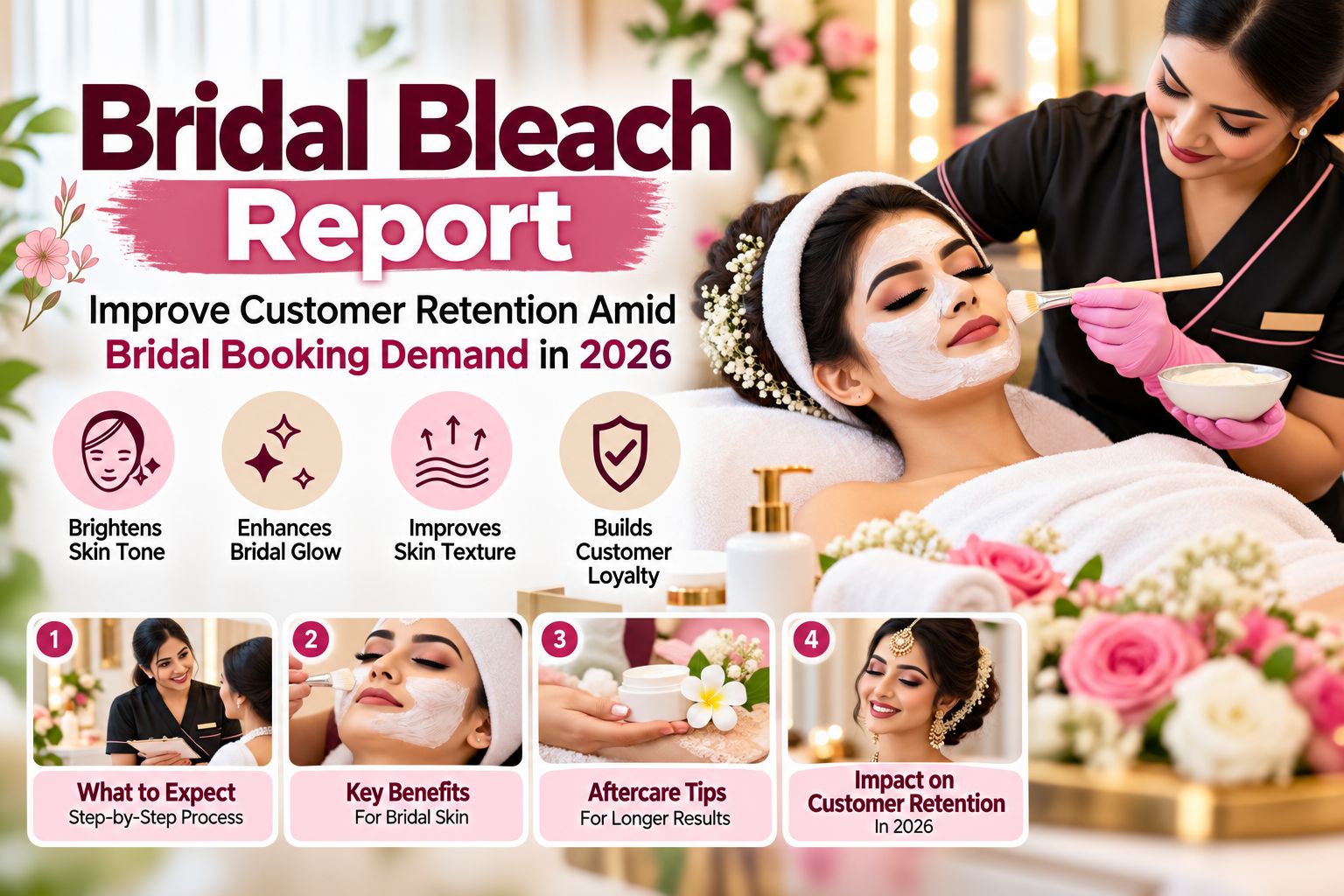


Bridal booking demand in 2026 gives salons a crowded calendar and a thin margin for error. One service sits at the centre of many of those bookings: bridal bleach. When a bride leaves with a result she did not expect, the problem rarely starts on the treatment bed. It starts at intake, carries through the patch test decision, and shows up weeks later as a lost rebooking. This bridal bleach report maps where a bridal bleach engagement breaks across the booking-to-aftercare sequence, and which salon-side signals tell you it is breaking.
Why Bridal Bleach Confusion Starts at the Booking Stage
The first strain usually appears before the service begins. When the calendar is full, consultations get trimmed, and a bride may confirm bleach without discussing her skin type, recent tan, or the number of days she has before the event. She then reads the result against the image she carried in, not against her own skin. Uneven tone, tightness, or a finish that looks duller than expected all read as failure to her, even when the service went exactly as planned. That gap is where retention quietly weakens.
What Bridal Bleach Actually Does on Indian Skin
This is the part that decides whether a bride returns for maintenance or stops answering calls. Bleach does not change skin permanently. It lightens existing hair and surface tone, and that effect is temporary. On Indian skin, the visible outcome depends on natural melanin, tan buildup, and how the skin responds to the bleaching agent on the day. A client with recent sun exposure or active acne may see uneven patches rather than a uniform glow. The result also softens over the following days as the skin settles back toward its natural tone. None of this is a defect. It is simply what the service does, and it is the single most useful thing to say out loud at booking.
Where Bridal Bleach Expectations Usually Break Down
Four points along the journey carry most of the risk. At booking intake, the bride confirms a date but not a realistic outcome, so her expectation is set by someone else. At the patch test decision, busy windows tempt salons to skip it, which removes the earliest warning of sensitivity. On service day, the result is judged in the first mirror look, before the skin has calmed, and no one has framed that moment for her. In the follow-up window, silence sets in, and any disappointment she felt has time to harden into a decision not to return. A vendor with a managed-review workflow typically handles this by inserting a short check at each stage rather than saving everything for a single aftercare message. The pattern matters more than the product used on the day.
Practical Decision Points for Salons and Brides
Treat the pre-event window as a working assumption, not a fixed rule. Booking bridal bleach roughly five to seven days before the main event is a reasonable starting point for many clients, but the right spacing depends on how sensitive the individual skin is, and it should be confirmed at intake rather than quoted as a standard.
Use symptoms as the trigger for a pause. If the skin feels tight, warm, or begins flaking within a day of the service, hold off on further bleach or exfoliation and let the barrier recover before the next function.
Treat the patch test as a decision, not a formality. A quick test on the inner arm or jawline before the full service gives the salon an early read on sensitivity, and it is the cheapest retention tool available during peak weeks.
Put aftercare in writing before she leaves the chair. Gentle moisturiser, sunscreen, and a short break from strong actives protect the result more reliably than any premium product applied on the day.
Know the boundary of the service. Bleach does not correct pigmentation, acne marks, or deep tan in one sitting, and adding layers will not make a temporary result last longer. When the skin is already irritated or highly sensitive, a professional reassessment is the safer next step than another application.
Salons that use parlourtime to track bridal service timing and follow-up reminders can see where these moments land in the calendar and set expectations before the booking is confirmed. Brides who are told plainly what bleach can and cannot do tend to come back for maintenance instead of dropping off after a first result they did not understand.
Common Field Signals and What They Mean
Fading before the wedding day points to a gap between what she expected and what a temporary service delivers. Explain the timeline at intake so the fade is anticipated, not discovered.
A request to repeat bleach before every function is a warning sign, not a scheduling note. Frequent repeats raise the risk of dryness, redness, and sensitivity, so space sessions with recovery time and say why.
A first-time reaction in a repeat client usually means something changed in her skin, her treatments, or her routine. The patch test still earns its place, even for familiar faces.
Uneven results are best met with a pause, not another layer. Let the skin recover, then review the right next step with her before the next event.
Rushed consultations during the peak season are where expectations quietly drift. Clear pre-service guidance and honest timelines protect the relationship more than the brand of bleach chosen.
Silence after the wedding is the clearest retention signal of all. A structured follow-up in the two weeks that follow tells you whether she is returning before she has decided.
Written by: Parlour Time Editorial Desk
Published: 26 September 2026, 11:31 AM IST | Updated: 26 September 2026, 11:31 AM IST
Powered by: Parlour Time