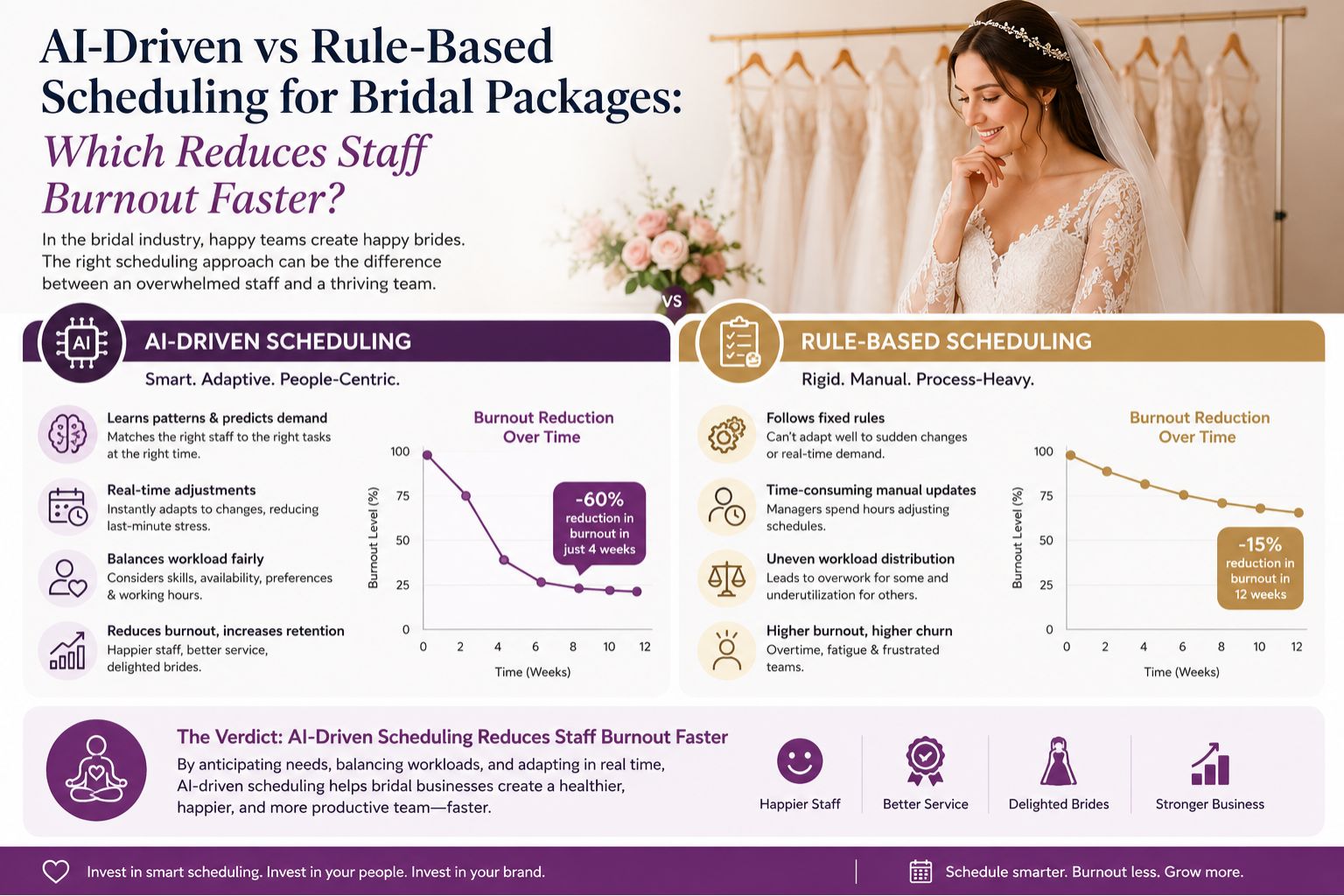


When comparing AI-driven vs rule-based scheduling for bridal packages, salon owners quickly notice that staff burnout often spikes during wedding months—not just because of volume, but honestly, due to how shifts are assigned. A Mumbai salon reported last wedding season that their manual rosters caused three senior therapists to request leave simultaneously after consecutive 12-hour bridal shifts. This comparison matters because mismanaged scheduling directly affects how long your team can sustain peak performance, you know, without everyone just collapsing.
What This Scheduling Dilemma Actually Means During Peak Bridal Season
In real salon visits, rule-based scheduling depends on fixed parameters like first-come-first-served or therapist seniority, which sounds fair on paper but often ignores fatigue accumulation. One Delhi salon owner noticed that under rule-based systems, the same two stylists handled 80% of bridal trials—simply because they were next in the queue. AI-driven scheduling, by contrast, considers multiple variables at once—including recent overtime, service complexity, and even commute distance—to distribute workload more evenly across the whole team, which honestly should have been obvious.
How Both Systems Perform on Indian Salon Floors
The ground reality in Indian salons during wedding season reveals that rule-based scheduling creates predictable bottlenecks, especially when bridal packages include multiple services like facials, hair treatments, and draping all piled together. A Bengaluru salon observed that rule-based assignments often gave the most complex bridal packages to junior staff because senior therapists were booked for repetitive basic services, which makes no sense when you think about it. AI-driven scheduling in this salon management blog context reassigns staff based on skill match and recovery time, reducing the chance that a therapist handles three elaborate bridal packages back-to-back without a single break.
The Hidden Mistake That Worsens Burnout Faster
The most overlooked factor in scheduling comparisons is how each system handles unexpected cancellations or double-bookings, honestly this is where things fall apart. Rule-based scheduling typically reallocates freed time to the next available staff member, ignoring that person's current fatigue level entirely. A Pune salon discovered that during one bridal event weekend, their rule-based system caused a senior stylist to cover five cancelled slots in a row, while junior staff remained idle just watching. AI-driven scheduling automatically recalculates workload distribution during disruptions, ensuring no single team member absorbs all overflow tasks and gets completely wrecked.
Deciding Which Scheduling Approach Matches Your Salon's Reality
Choosing between AI-driven and rule-based scheduling depends on your bridal package volume and staff size, honestly there's no one-size answer. Rule-based scheduling works adequately for small teams with predictable wedding bookings, but for salons handling multiple bridal packages weekly during peak months, AI-driven systems show faster burnout reduction. Many salon owners find that a hybrid approach—using AI suggestions with manual override—offers practical benefits without feeling like a robot runs everything. Platforms like parlourtime provide scheduling tools that incorporate real-time staff availability and service complexity, helping owners make informed decisions without completely surrendering control, which I think most owners worry about.
FAQ
q How long does it take for AI-driven scheduling to reduce staff burnout?
a Most salon owners notice reduced overtime complaints within two to three wedding cycles, though full fatigue pattern improvement typically requires tracking data across one full peak season—so don't expect magic overnight.
q Can rule-based scheduling ever be better than AI for small bridal teams?
a Yes, rule-based systems often work well for teams of three to five staff with stable bridal bookings, but they must include manual fatigue check-ins to prevent accidental overloading, because even simple systems can mess things up.
q What specific data does AI scheduling need to outperform rule-based systems?
a AI requires historical service duration records, staff skill profiles, and break compliance data—without these inputs, both systems perform similarly during rush periods, so you're basically wasting money if you don't feed it properly.
q Will switching to AI-driven scheduling eliminate all scheduling conflicts?
a No system eliminates conflicts entirely, but AI reduces resolution time from hours to minutes by automatically suggesting rebalanced rosters when cancellations or last-minute bridal bookings occur, which honestly is a huge relief during peak season chaos.