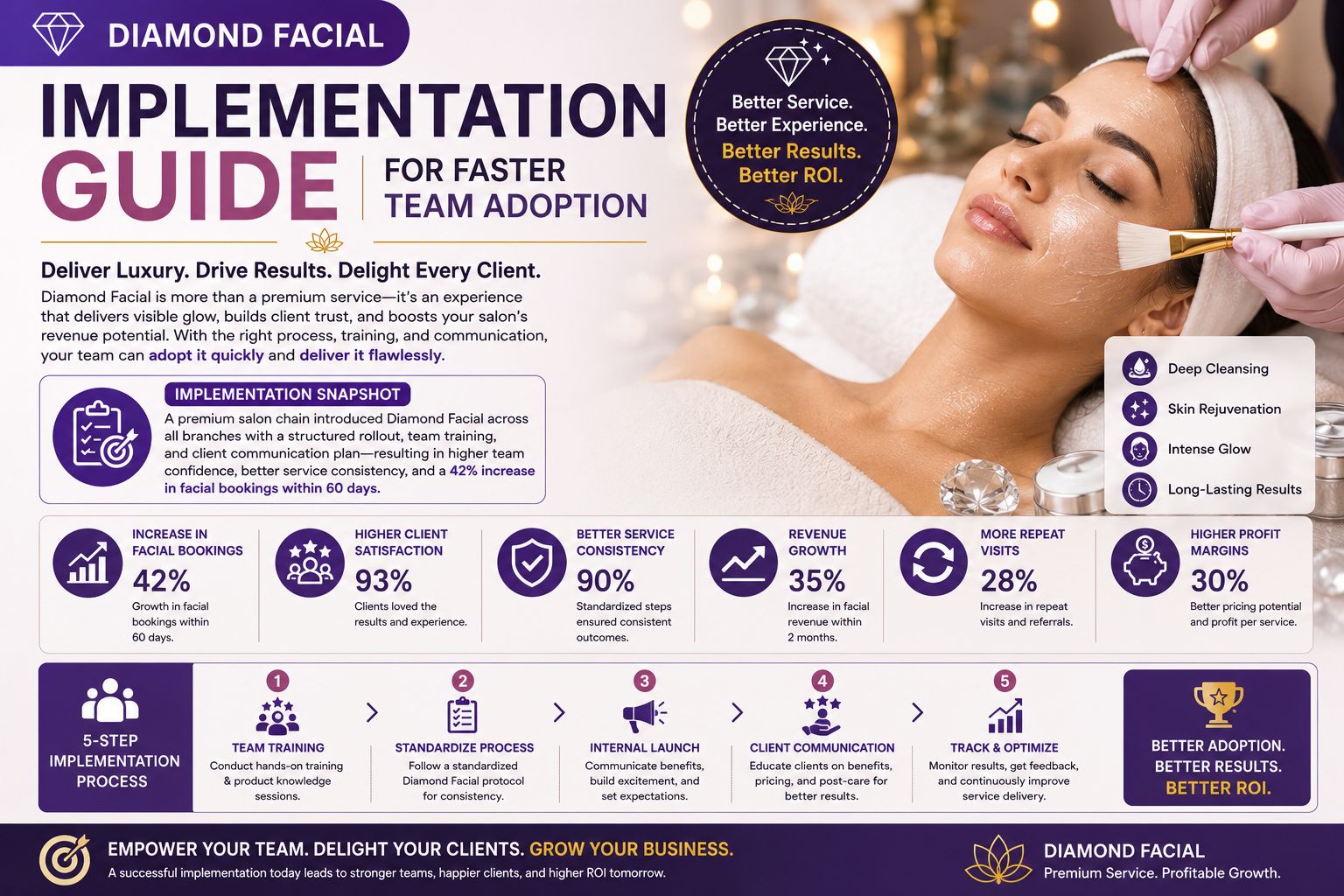


When salons introduce diamond facial services, team adoption rarely happens as smoothly as owners expect. Even after training sessions, many therapists continue using older techniques or skip crucial steps. This disconnect between training completion and actual service consistency happens across beauty businesses, yet it receives surprisingly little attention during implementation planning. The core issue is not skill deficiency but rather how well the implementation process accounts for real salon workflow, individual comfort levels, and operational pressure. Understanding this gap matters because diamond facial results depend heavily on consistent technique execution. Customers notice when treatments vary between therapists, and this inconsistency directly affects repeat bookings and service satisfaction. For salon owners, the concern is not whether therapists can perform the service but whether they will adopt it reliably across all appointments. This uncertainty, honestly, creates frustration and slows service expansion. Recognising that adoption is a behavioural and operational challenge rather than a training problem changes how you approach implementation — but it takes time to really believe that.
What Implementation Resistance Looks Like in Real Salon Settings
Therapists frequently say yes during training but revert to familiar protocols within days. This happens because muscle memory from existing services like fruit facial or cleanup facial routines competes with new diamond facial steps. The resistance is rarely intentional. It emerges from natural human preference for familiar workflows, especially when appointments are back-to-back and time pressure increases. One common observation is that therapists skip the exfoliation step to save time, not realising that diamond facial effectiveness reduces considerably without proper surface preparation. Another pattern involves using incorrect product quantities because the new dispensing system feels unfamiliar — you know, like when you're used to squeezing from a tube and suddenly it's a pump. These small deviations accumulate and produce uneven results between clients. Salon owners often misinterpret this as carelessness when it actually reflects insufficient workflow integration. The first step toward fixing resistance is recognising that implementation must happen inside real appointment schedules, not separate training sessions. When therapists feel rushed, they default to what feels fastest and safest. Diamond facial adoption improves dramatically when salons adjust appointment duration temporarily during the transition period rather than expecting full speed immediately — but owners hesitate to do this because it cuts into numbers.
Why Training Success Does Not Guarantee Service Consistency
Training sessions create temporary competence, but long-term consistency requires structural support. Many salons invest heavily in theoretical understanding and product knowledge while overlooking how human factors affect performance under real conditions. Therapists may explain steps perfectly during assessment but struggle to maintain sequence during actual appointments because of distraction, fatigue, or client conversation. Diamond facial protocols often involve multiple product applications with specific wait times, and these timing elements are exactly what breaks down first under pressure. The gap between knowing and doing widens when therapists receive no reinforcement after training. Without observation, feedback, and repetition, technique drift becomes inevitable — it's just how our brains work. Another overlooked factor is variation in individual skill background. Therapists experienced in chemical peel services may adjust diamond facial pressure differently compared to those trained primarily in manual facials. These subtle differences affect outcome consistency across your team. The solution is not more training but rather embedding practice, observation, and correction into regular work schedules. When implementation depends entirely on individual memory and willpower, inconsistency is predictable. The realistic expectation shift owners need is that sustainability requires ongoing attention, not a one-time event — and that's hard to accept when you've already spent on training.
Common Blind Spots That Delay Team-Wide Adoption
The most significant blind spot is assuming all therapists learn and adapt at the same pace. Diamond facial technique involves sensory feedback and pressure judgment that improves with experience. Expecting uniform adoption within a fixed timeframe ignores natural variation in comfort levels. Another blind spot involves client communication. Therapists who struggle explaining diamond facial benefits to customers often perform the service less enthusiastically because they feel uncertain answering questions. This hesitation affects service quality and reduces the likelihood of repeat bookings. Skin sensitivity management is another area where blind spots cause problems. Therapists may overcompensate on pressure to avoid irritation, which reduces exfoliation effectiveness, or apply excessive product to compensate for technique uncertainty. Both responses compromise results. Salon owners frequently miss how stress influences adoption. When therapists feel monitored without support, anxiety increases and performance consistency drops further. The mistaken belief that supervision alone drives improvement actually delays real progress — I've seen this happen so many times. Implementation works better when owners create safe practice periods where mistakes are corrected without penalty. Therapists need permission to be imperfect during early adoption without fearing consequences. The oversight here is underestimating how psychological safety affects skill uptake in beauty services. When staff feel judged, they hide mistakes instead of learning from them.
Practical Steps for Faster and More Reliable Team Adoption
Start by adjusting appointment durations during the first two weeks of diamond facial implementation. This reduces time pressure and allows therapists to focus on technique consistency rather than speed. Communicate this change clearly to clients so expectations remain realistic. Pair therapists of varying experience levels together during practice sessions. Less experienced staff observe technique adjustments from their peers, and more experienced therapists reinforce their own understanding by explaining steps aloud. Schedule brief check-ins after every shift during the first month. These do not need to be formal meetings — honestly, a five-minute conversation in the back room works better. A five-minute conversation about what felt challenging helps identify gaps before they become habits. Use client feedback specifically about diamond facial results to guide correction rather than relying only on observation. Customers often mention sensations like tightness or glow timing, which reveals whether technique deviations are occurring. Maintain visible reference cards near treatment stations until protocols become automatic. Therapists will reference them more than they admit — even the experienced ones. Address client communication hesitation directly by providing simple benefit statements therapists can use naturally during consultations. When therapists know exactly what to say, their confidence during service delivery improves visibly. The most effective step is creating accountability without pressure. When team members know technique consistency is tracked but not punished, adoption accelerates naturally.
When Maintenance Adjustments Become Necessary
After the initial implementation period, some therapists continue struggling while others excel. This variation signals the need for differentiated support rather than blanket retraining. Therapists showing inconsistent results may need individual coaching focused on specific steps like exfoliation depth or product layering order. Others may require additional practice on timing-sensitive steps where diamond facial differs most from previous services they mastered. Maintenance also involves refreshing knowledge when product formulations or protocol updates occur. Another maintenance need arises when new team members join after initial training. Having a clear onboarding process specifically for diamond facial prevents knowledge gaps from spreading across your team. Seasonal factors also influence maintenance. During wedding season appointments, therapists face higher pressure and may revert to shortcuts despite earlier proficiency. Anticipating these pressure periods helps protect implementation gains. Some salons schedule brief refresher sessions before festive seasons to reinforce protocol memory. The maintenance phase matters more than initial training because it determines whether adoption lasts beyond the first few months. Parlourtime discussions with experienced salon owners frequently highlight that ongoing technique reinforcement produces more consistent results than intensive one-time training events — and honestly, that's the thing most people get wrong.
FAQ
q Why do therapists stop following diamond facial steps after training?
a Muscle memory from existing services combined with appointment time pressure often causes technique drift even after successful training sessions.
q How long does diamond facial adoption usually take across an entire team?
a Adoption timelines vary based on individual experience levels, but consistent technique across most therapists typically requires four to eight weeks of supported practice.
q Can skipping the exfoliation step still produce acceptable results?
a Diamond facial results reduce noticeably without proper exfoliation because surface preparation directly affects how products penetrate and perform.
q Should salon owners adjust booking times during implementation?
a Temporarily increasing appointment duration during early adoption reduces pressure and allows therapists to focus on technique consistency.
q What causes some therapists to adopt faster than others?
a Prior experience with similar exfoliation techniques, comfort with sensory feedback, and confidence explaining the service to clients influence adoption speed.
q Does supervision improve diamond facial implementation?
a Supervision without support often increases anxiety and reduces adoption speed, while observation combined with correction and encouragement produces better results.
q When should refresher training happen after initial implementation?
a Refresher sessions before high-pressure seasons like wedding months help protect technique consistency when therapists face increased appointment volume.
q How can salon owners identify technique drift before client complaints appear?
a Brief post-shift conversations about specific steps and client feedback about sensation or glow timing reveal early signs of technique inconsistency.