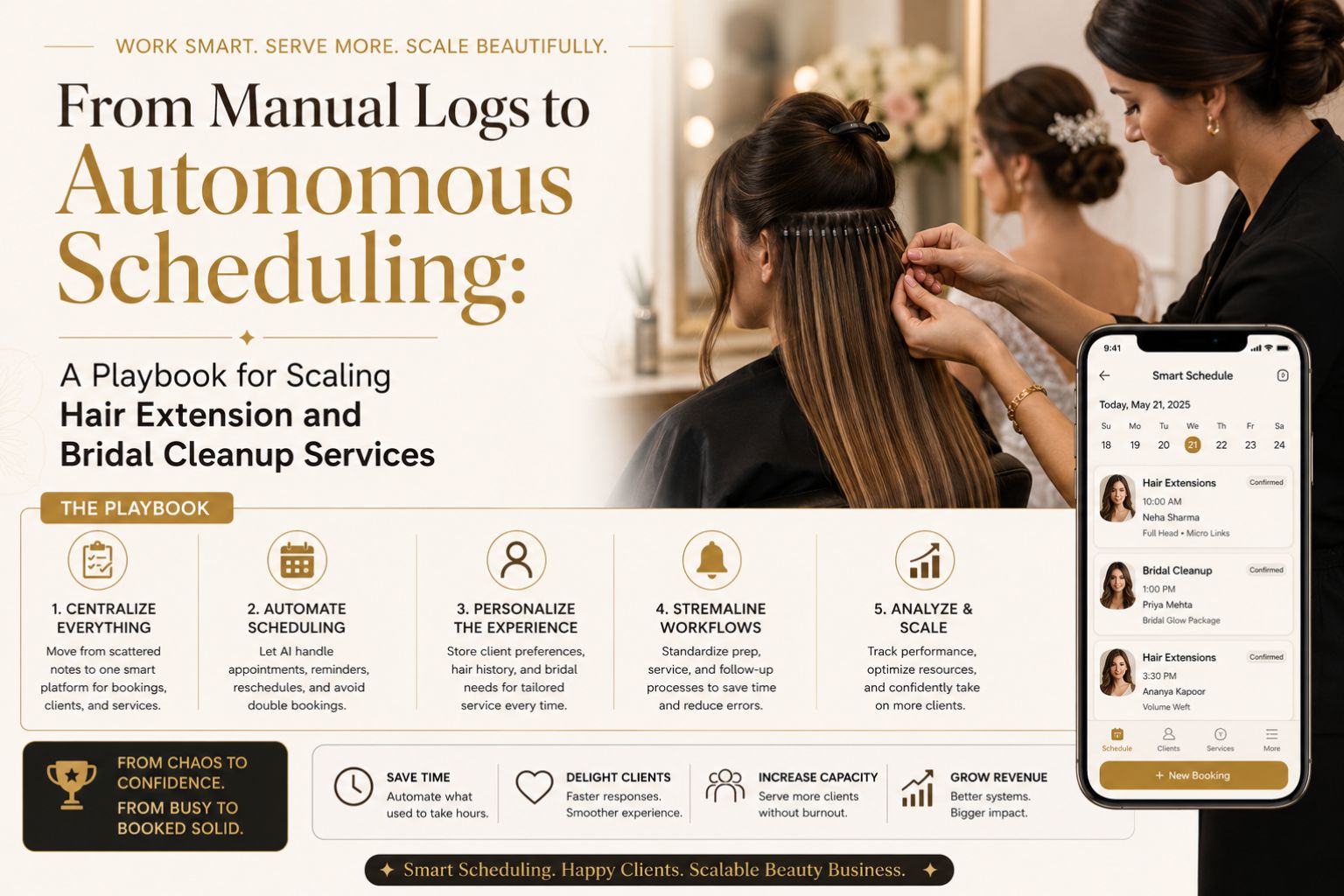


If you are still managing hair extension and bridal cleanup bookings on paper logs or spreadsheets, you are already losing time and revenue. Manual logs create bottlenecks, double-bookings, and missed appointments that frustrate both your clients and your team. Moving to autonomous scheduling is not just about convenience—it is the only way to scale without sacrificing service quality. Many salon owners overlook that manual systems cannot handle the complexity of overlapping services like hair extensions and bridal cleanups, which often require precise timing and resource allocation—and honestly, most people don't even think about how one late bridal cleanup can ruin two other appointments.
What Manual Logs Really Cost Your Salon Business
Relying on manual logs for scheduling hair extension and bridal cleanup services means you are constantly fighting against human error. A real salon observation shows that even experienced receptionists accidentally double-book a stylist for a bridal cleanup and a hair extension appointment, leading to client dissatisfaction and lost revenue. The non-obvious detail people overlook is that manual logs provide zero data on service duration or client history—you cannot predict that a bridal cleanup after a wedding reception takes at least 90 minutes, not 45—and trust me, I've seen brides walk out furious when their stylist rushes. Without this clarity, your team is always guessing, and your clients pay the price.
The Reality of Scaling with Spreadsheets and Paper Grids
Scaling hair extension and bridal cleanup services with spreadsheets or paper grids is a path to operational chaos. What actually happens on Indian salon floors is that stylists end up working overtime because the schedule has no buffer for hair extension application or bridal makeup removal. A common service dependency is that bridal cleanups often require the same stylist who did the bridal makeup, meaning if your manual log does not link these appointments, you create conflicts—I've seen this happen in my own parlor when two brides wanted the same artist. The boundary where this stops working is when you have more than three stylists—suddenly, you cannot track availability without spending hours every day on updates.
The Mistake of Ignoring Service Complexity in Scheduling
The biggest mistake salon owners make is assuming that hair extension and bridal cleanup services can be scheduled with the same simple system used for basic haircuts—it sounds obvious, but so many people do it anyway. Wrong assumptions like these lead to disaster—a skin sensitivity test needed before a hair extension service is skipped because the manual log forgot to flag it, leading to a client reaction. Another common misunderstanding causing dissatisfaction is that clients think they can book a bridal cleanup immediately after the wedding, but they overlook that the bride needs at least 30 minutes of skin cooling before peels or cleaning—and honestly, who tells them that? This blind spot in service planning creates friction that blocks scaling.
How to Decide the Right Time to Shift to Autonomous Scheduling
You should consider moving to autonomous scheduling when you notice that manual logs cause more than two scheduling conflicts per week during event season, especially for bridal services—and I'm not exaggerating, I've been there. The timing constraint to watch for is during bridal preparation months like November to February—if your team is constantly calling clients to reschedule, it is time to act. A key factor for Indian skin conditions is that clients with sensitive skin need longer gaps between hair treatments and facials, which only automated systems can gracefully manage. Using a platform like parlourtime helps you visualize these dependencies so you can scale without stress. For more insights on optimizing your salon operations, check out our guide on salon workflow improvements.
FAQ
q What is the first sign my salon has outgrown manual logs?
a The first sign is when double-bookings happen more than once a week, especially for time-sensitive services like bridal cleanups or hair extension applications—and honestly, if you're still using paper, this is probably already happening.
q Can autonomous scheduling handle skin sensitivity issues before hair extension services?
a Yes, modern scheduling platforms can flag mandatory skin patch tests before any hair extension service, ensuring you avoid allergic reactions and client complaints—something manual logs usually miss.
q How long does it take to migrate from paper logs to an autonomous scheduling system?
a Many salons complete the transition in one to two weeks, including training staff on features like service duration tracking and client history notes—though you might need a few extra days if your staff is tech-shy.
q Will autonomous scheduling help me manage bridal cleanup bookings during peak wedding season?
a Absolutely, because automated systems can block stylist availability based on the actual time needed for a full bridal cleanup, which is often longer than expected—and trust me, brides don't like being rushed out.