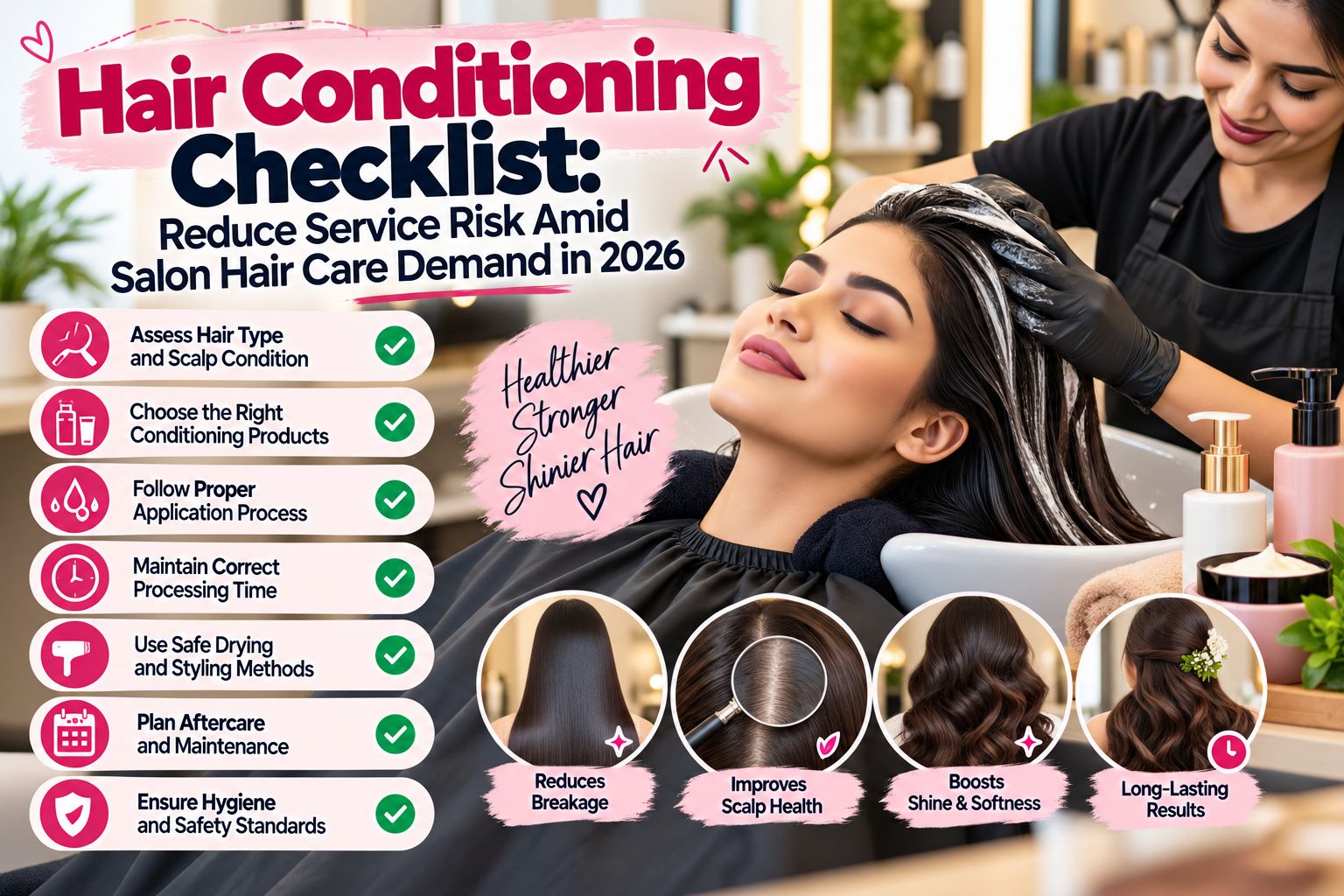


A hair conditioning checklist turns a vague salon conversation into a set of verifiable steps. Service risk here means the chance that a conditioning service looks good in the chair but behaves differently at home, or that a repeat visit causes more dryness than repair. This checklist is written for stylists and salon teams who want the same standard followed at every chair, and for clients who want to know what a proper conditioning service should include. It runs in order: consultation, product selection, application, rinse, aftercare, then reassessment. The 2026 in the title marks the publication year of this checklist, not a claim about market conditions.
The checklist below is built on internal service-process knowledge only. It makes no market or trend claim, and it does not promise a fixed result.
Consultation checkpoint before any conditioning begins
Record scalp condition first. Look for flaking, itching, redness, or tightness before touching the strands, because a conditioning service applied over an irritated scalp often adds discomfort instead of improving the finish.
Note the service history. Ask when the last colour, smoothening, keratin, or repair service happened, since hair carrying recent chemical work responds differently from untreated hair.
Confirm the client's expectation in their own words. Softness, frizz control, and shine are three different goals, and a written note of which one matters most keeps the service tied to the actual request.
Decide the go/no-go pause. If the scalp shows active irritation or the hair is still settling from a recent chemical service, pause and reassess rather than proceeding on the same day.
Product selection checkpoint for conditioning services
Match the product to porosity, not to the treatment name. High-porosity hair absorbs and releases moisture quickly, so a heavier mask may sit on the surface while a lighter one works better.
Check compatibility with the client's home products. Ask what shampoo and styling products they use, because a harsh cleanser at home shortens how long any in-salon result lasts.
Verify the patch test when the scalp is sensitive. A short patch test before a scalp-adjacent service catches sensitivity early, when it is easy to change the plan.
Keep one variable at a time. If the previous session used a specific mask, do not change both the product and the application time in the same visit, or you lose the ability to tell what worked.
Application checkpoint during the service
Section the hair evenly. Uneven sections are the most common reason for a result that feels smooth in some places and coated in others.
Keep most of the product off the scalp unless the product is designed for it. Conditioning masks belong on mid-lengths and ends, where dryness usually sits.
Watch the clock honestly. Leaving a mask on longer than the label states does not add repair and can leave hair feeling heavy.
Log the timing and product used. A short note in the client record makes the next visit a comparison rather than a guess.
Rinse and aftercare checkpoint for lasting results
Rinse until the water runs clear and the hair stops feeling slippery. Residual product weighs hair down and mimics damage within a few washes.
Check the finish while the hair is still damp. Uneven smoothness at the ends at this stage usually points to pre-existing damage, not a poor application.
Hand over a written aftercare routine. Name the shampoo, the wash frequency, and the heat-styling limit, because aftercare is where service consistency is won or lost.
Set the next review date. Ask the client to report how the result behaves after three to four washes, when the true performance shows up.
Practical checks and reassessment triggers
Result fades within a few washes review home products before repeating the service, since incompatible shampoo or frequent heat styling is a common cause.
Scalp sensitivity appears stop the service, record what was used, and reassess before the next appointment rather than continuing the same routine.
Ends feel brittle while the mid-lengths feel soft shift from a repeat conditioning service to a repair-focused plan for the ends.
Client wants a service close to an event choose a lighter option such as a cleanup or hair spa, because a strong chemical service leaves no recovery window.
Previous service has not fully settled wait and reassess instead of stacking another treatment, since cumulative work is what usually increases dryness.
Client asks about service timing and maintenance point them to hair care resources and beauty service questions so expectations are set before the booking, not after.
Scope note: this checklist is built on internal service-process knowledge only. It makes no market or trend claim, and results still depend on each client's hair condition, scalp health, and home routine.
Written by: Parlour Time Editorial Desk
Published: 04 October 2026, 12:12 AM IST | Updated: 04 October 2026, 12:12 AM IST
Powered by: Parlour Time