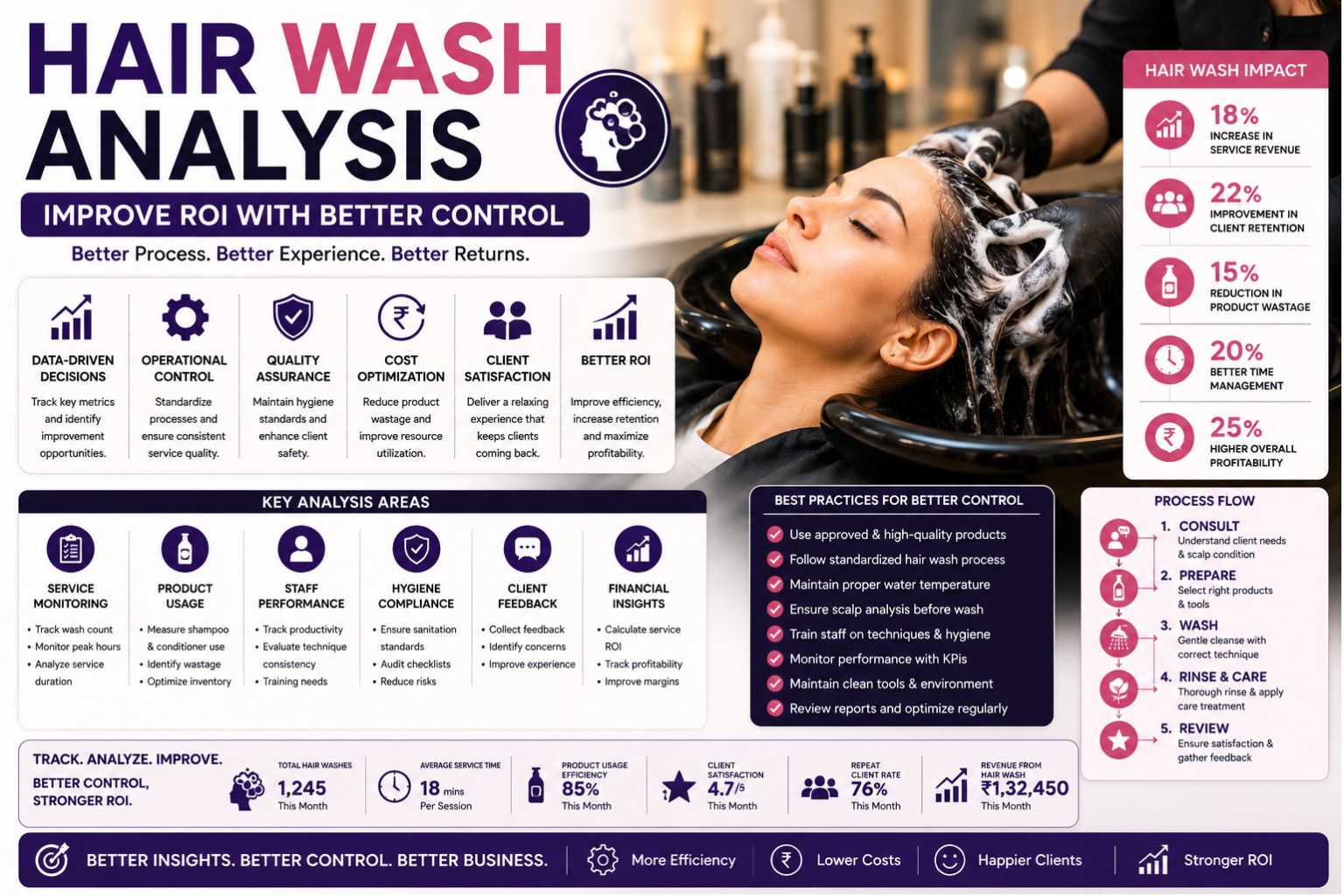


Hair wash services often seem like a low-value add-on, but a careful hair wash analysis reveals that poor control over products, timing, and technique significantly impacts your salon's return on investment. Many salon owners notice that product consumption per client varies wildly, and appointment times for the same service—like, same hair length same request—differ so much between stylists. This inconsistency directly reduces profitability and creates client confusion. Understanding exactly where these inefficiencies hide is the first step toward improving your salon's financial performance. When you establish better control, you transform a routine service into a predictable profit center. Honestly though, easier said than done.
Understanding Where Profit Disappears in Hair Wash Services
The first sign of trouble in your hair wash service is inconsistent product usage. One stylist might use double the amount of shampoo or conditioner compared to another for the same hair length and texture. This variability leads to higher inventory costs and frequent stockouts. Many salon professionals overlook that the cost of products used per wash directly erodes the service margin. Additionally, time spent per client often stretches beyond the scheduled appointment, reducing the number of daily services a stylist can complete. When you lack visibility into these factors—like, you don't even know who's using how much—your salon's ROI suffers silently. The goal is to identify these leakage points through a structured analysis of your current workflow.
Reality Check: Factors That Influence Your Hair Wash ROI
The reality is that product effectiveness and client satisfaction depend on several overlapping factors. Hair type, scalp condition, and water temperature all affect how much product is needed and how long the service takes. For instance, clients with thick, curly hair often require more product and a longer rinse cycle than those with fine, straight hair. Seasonal changes like humidity or monsoon dampness also influence scalp oiliness, which changes product consumption. Furthermore, stylist training levels vary, meaning some professionals may overcompensate with extra product to ensure cleanliness. These natural variations must be accounted for before you can set realistic benchmarks. A generic approach to pricing or product allocation simply does not work across diverse client bases. Honestly, I've seen salons try and they just lose money.
Common Mistakes That Destroy Your Hair Wash Profitability
A major blind spot in many salons is the lack of standard operating procedures for hair wash services. Without clear guidelines, stylists use their own judgment, leading to unpredictable results and waste. Another overlooked risk is failing to track product usage per client or per service category. When you do not measure consumption, you cannot control it. Many salon owners also assume that using premium products automatically justifies a higher price point, but they forget to account for the increased per-wash cost. This oversight directly reduces net profit. Additionally, rushing through the service to meet appointment times often leads to poor rinsing, which causes product buildup and client dissatisfaction. These mistakes accumulate and significantly damage your salon's bottom line over time. It's like a slow leak you don't notice until the tank is empty.
Decision Help: How to Regain Control Over Your Hair Wash Services
To improve your ROI, begin by conducting a detailed audit of your current hair wash process. Measure the average amount of shampoo, conditioner, and water used per client across different hair types. Schedule dedicated time for a team meeting to discuss these findings and establish clear product usage guidelines. Consider implementing a portioning system, such as pre-measured bottles or pump dispensers, to limit waste. Invest in short training sessions focused on efficient water use and rinsing techniques. Use a salon management tool to track service time per stylist and identify outliers. Some salons find that adjusting their service menu to include a "basic wash" and a "premium wash" option helps manage client expectations and product costs. The boundary to recognize is that even the best control system cannot compensate for untrained staff. When you repeatedly see a stylist's product waste remain high after training, a professional reassessment is needed. For further guidance on optimizing service workflows, you can explore relevant salon management resources that discuss operational efficiency. But honestly, don't just read—actually apply it.
q What is the average profit margin on a basic hair wash service?
a Profit margins vary, but many salons find a basic hair wash service has a margin between 60% to 80% before accounting for time and overhead.
q How can I measure the exact product cost per hair wash?
a Track the volume of shampoo and conditioner used per client by measuring bottle weight before and after service, then multiply by cost per ml.
q Does using expensive shampoo always lower my ROI?
a Not necessarily, but premium products must be priced appropriately in your service menu to cover the higher cost and maintain profitability.
q Can poor rinsing technique affect my salon's reputation?
a Yes, inadequate rinsing leads to product buildup, scalp irritation, and dull hair, which causes negative reviews and reduced repeat business.
q What is the optimal time to allocate for a standard hair wash?
a A standard hair wash typically requires 10 to 15 minutes for efficient service without rushing, accounting for wetting, shampooing, conditioning, and rinsing.
q How do seasonal changes impact my hair wash product consumption?
a During humid or rainy seasons, clients may have oilier scalps requiring more product, whereas dry seasons might reduce the amount of conditioner needed.
q Should I train my stylists on water conservation techniques?
a Yes, training on efficient water use can significantly reduce utility bills and service time, directly improving your overall operational ROI.
q How often should I review my hair wash service costs and pricing?
a Review your product costs and pricing at least quarterly, or whenever you change product lines, to ensure your margins remain healthy and competitive.