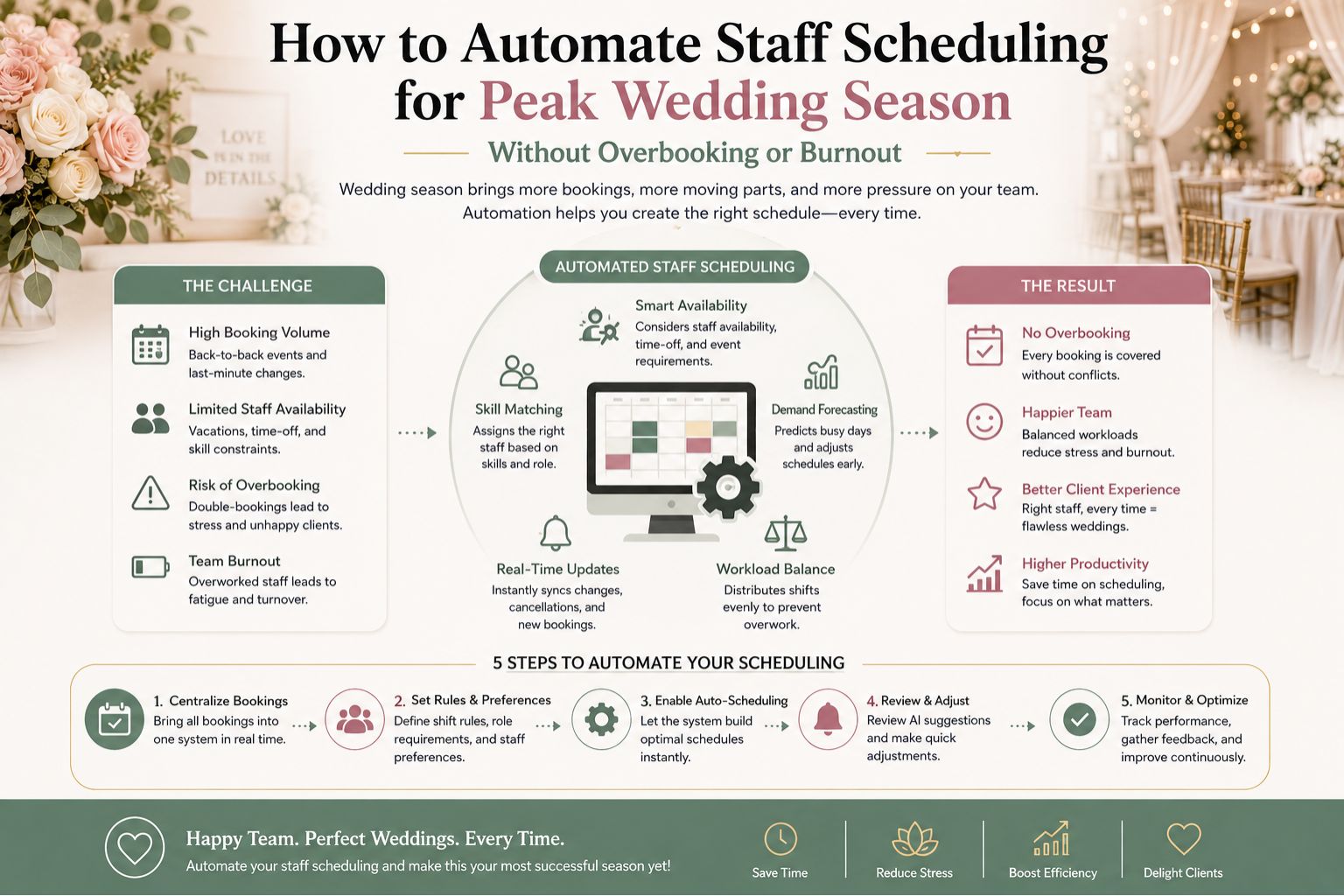


Peak wedding season brings a flood of bridal bookings, and if your salon relies on manual sheets or group chats to manage staff scheduling, you are almost guaranteed to face overbooking or burnout. The pressure to serve every bride fast often leads to double-booked stylists or exhausted teams handling back-to-back hair treatments and makeup sessions. Without a proper system, your staff will feel the strain, and the quality of their work, especially on delicate services like a bridal facial or keratin treatment, will drop. The real problem is not the volume of bookings exactly—it's the lack of a structured system that respects both client demand and employee limits. Honestly, automating staff scheduling for peak wedding season is the only reliable way to keep your team energized and your appointments error-free.
What Manual Scheduling Does to Your Team During Wedding Rush
When you use pen and paper or basic spreadsheets to assign wedding appointments, you miss real-time visibility into each staff member's workload. A common real salon observation is that senior stylists end up handling three consecutive bridal hair settings without a break, while junior staff sit idle. This leads to delayed services, skipped lunch breaks, and a dip in service quality if I'm being honest. Staff scheduling for peak wedding season becomes a guessing game instead of a precise allocation of tasks, and that's where everything starts slipping.
The Reality of Overbooking and Burnout in Indian Salons
Indian wedding season brings a unique pressure where a single bride may book three separate services, a bridal facial, a hair smoothening touch-up, and a mehendi session, all on the same day. Manual scheduling often fails to account for these overlapping service dependencies. The result is that a staff member assigned to back-to-back hair treatments may have no buffer time if a previous appointment runs long. This non-obvious detail—the lack of buffer zones—is what quietly causes burnout because there is no physical or mental recovery gap between clients. And trust me, your team feels it.
The Common Mistake of Relying on Staff Memory and WhatsApp Chains
Many salon owners assume that their senior staff will remember their own schedules or that a WhatsApp group message will keep everyone updated. This is a common misunderstanding causing dissatisfaction. A single missed message about a timing change or a double booking for a bridal appointment can cascade into a full day of chaos. Staff scheduling for peak wedding season must move beyond memory-based systems because even the best employee cannot track fifteen bridal bookings accurately without digital help. The boundary where manual management stops working is the moment you have more than two stylists working simultaneously on different wedding packages—that's when the cracks really show.
How to Choose the Right Automation Tool for Wedding Season Scheduling
When deciding how to automate, look for a system that balances business needs and employee welfare without requiring expensive software training. The best approach is to prioritize tools that show real-time availabilities, automatically enforce rest periods between back-to-back appointments, and flag potential double bookings before they happen. A good rule of thumb is to test the system on a single wedding weekend before rolling it out for the full season. This decision helps you avoid system errors during the peak rush and gives your team time to adjust—it's better to catch hiccups early. For more practical advice on salon operations, explore our blogs on salon management strategies that cover real-world booking challenges. Staff scheduling for peak wedding season should also include staff input on their preferred shift slots, which reduces resentment and prevents the burnout that comes from rigid assignments.
FAQ
q: What is the easiest way to start automating staff schedules for wedding season?
a: The easiest way is to adopt a scheduling platform that integrates with your existing booking flow, such as Parlourtime, which allows you to assign staff per service and see availability instantly, preventing overbooking from day one.
q: How can I prevent my stylists from feeling burned out during back-to-back bridal appointments?
a: Set a mandatory buffer of at least 15 minutes between each bridal appointment within your scheduling tool, which gives the staff time to sanitize tools, hydrate, and reset before the next client, reducing physical and mental fatigue.
q: Is it possible to automate scheduling without replacing my existing booking software?
a: Yes, many standalone scheduling add-ons and apps can plug into your current system via calendar sync, so you do not need to overhaul your entire setup to get automated conflict detection and staff workload visibility.
q: How do I handle a situation where a bride wants to change her appointment timing at the last minute during peak season?
a: Use a system that allows instant rescheduling with staff availability snapshots, so when a bride changes timing, you can immediately see which stylist is free next without calling or texting them, preventing manual errors and reducing team stress.