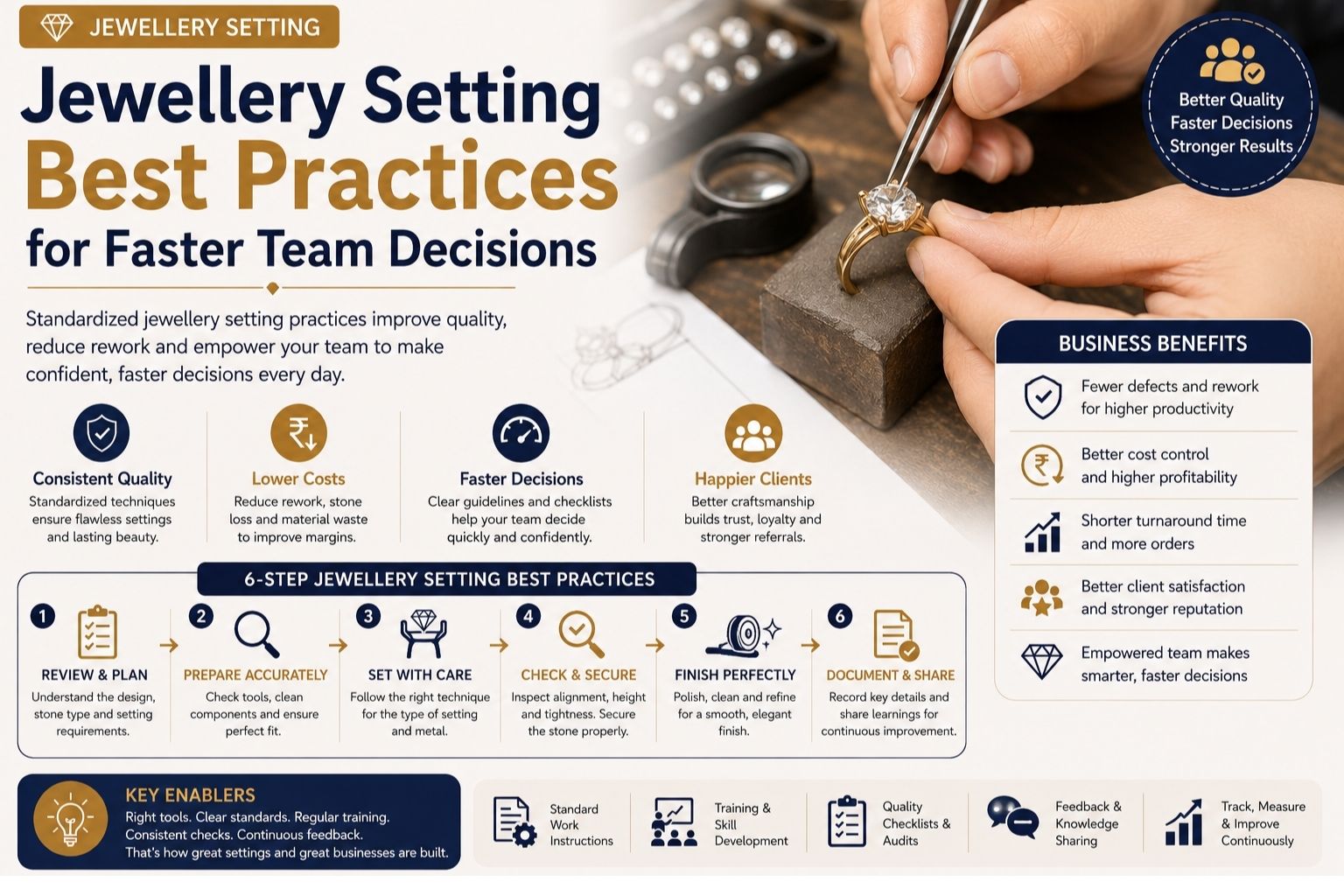


Jewellery setting best practices often get discussed only after a piece is already ruined. In real workshops, the decision to set a stone is rarely a solo act. Bench jewellers, designers, and studio managers all have input, and that is where delays begin. When a team cannot agree on the setting method, stone placement, or finishing standard, work sits idle. The uncertainty is not about skill. It is about having no clear framework for making quick, confident decisions. This article explains why jewellery setting decisions stall, what really influences outcomes, and how teams can move faster without sacrificing quality.
Why Jewellery Setting Decisions Stall in Busy Studios
Most workshop delays start with a simple question: who approves the setting plan? In many studios, the designer expects one result, the setter understands another, and the owner worries about cost. Each person sees a different priority. A designer might push for a delicate pave setting that takes hours. The setter knows the metal is too thin for that approach. The owner is watching the clock. This misalignment causes rework, not because anyone is careless, but because no one established the boundaries before work began.
Teams often notice the problem first during the approval stage. A stone is placed, the piece comes back from polishing, and suddenly someone questions the height of the prongs. That is a late-stage discovery. When decisions are postponed until after the fact, the entire production schedule shifts. The clarity that should exist before the burr touches the metal is missing. Many teams confuse activity with progress, assuming that because the bench is busy, the workflow is healthy.
The deeper issue is that setting decisions are treated as subjective. One jeweller prefers channel settings for security. Another favours prongs for brilliance. Without a shared standard, these preferences become arguments. The fastest way to break this pattern is to separate personal taste from technical requirements. A setting decision should rest on stone security, metal integrity, and the intended wear of the piece. Once those facts are on the table, the conversation becomes about engineering, not ego.
Reality Check: What Actually Influences Setting Outcomes
The reality of jewellery setting is that results vary even when the same jeweller works on similar pieces. Stone hardness matters. A diamond behaves differently from an emerald. Emerald cuts have fragile corners that chip easily under pressure. Princess cuts require precise prong placement to protect the corners. Teams that ignore these material facts end up blaming the setter when the real issue is stone geometry. The condition of the mounting is equally critical. Castings with porosity or thin walls will fail regardless of the setter’s skill.
Another overlooked factor is the sequence of operations. Setting before polishing risks damaging the stone. Polishing before setting risks scratching the metal with the setting tools. There is no universal answer. It depends on the design. A bezel setting might tolerate a final polish after setting, but a pave setting with tiny stones is safer when the metal is pre-polished. Teams that standardise one sequence for every job often create the very defects they try to avoid. The metal type also changes the equation. Platinum behaves differently than 18k gold. It work-hardens quickly, so the setter has less time to adjust a prong before the metal becomes too stiff.
Comfort with tooling is a major hidden variable. A setter who trained with hand tools will have a different rhythm than one who relies on a pneumatic hammer. Neither is better, but they are different. When a team assumes everyone works the same way, the handoff becomes clumsy. The perception that one method is universally faster is false. Speed comes from familiarity, not from the tool itself. The goal is to establish the condition of the metal and stone before starting. This prevents the most common failure: restarting the setting process halfway through because the approach was wrong.
Common Mistakes That Create Rework and Delays
The most common mistake in jewellery setting is assuming that a tight fit is always the correct fit. A stone forced into a setting that is too small creates stress fractures. This is especially dangerous with softer stones like opals or tanzanites. Another mistake is ignoring the girdle thickness. A stone with a thick girdle sits higher, which changes the prong length needed. When the setter does not measure the stone first, the prongs are cut short, and the stone is not held securely. The piece then fails the final inspection, and the setter must redo the work with a new setting.
Teams often overlook the condition of the burr and cutting tools. A dull burr generates heat, which can burn the metal or discolor a sensitive stone. This is a silent problem. The setter feels more resistance but assumes the metal is hard. The real issue is tool wear. Replacing or sharpening tools is not a delay; it is a time saver. The same logic applies to the magnification level. A setter working under a 3x loupe will miss details that a 10x loupe reveals. If the team has not agreed on the inspection standard, defects slip through to the customer.
A significant blind spot is the lack of a formal problem-solving protocol. When a stone breaks during setting, the immediate reaction is often blame. The designer says the setter was careless. The setter says the stone was flawed. This does not fix the piece. A better approach is to document the failure condition. Was the stone included? Was the metal too thin? Did the design require an unsupported bridge? These observations are data. Over time, the team can identify patterns and avoid the same mistake. Without this system, every broken stone is a new crisis, and the team cannot move forward quickly.
Decision Help: How to Build a Faster Workflow
To make faster decisions, start by setting a standard for stone measurement and metal inspection before any work begins. A simple checklist works well. The stone is measured. The setting is inspected for porosity. The metal thickness is verified. This takes five minutes and saves hours. If the piece does not meet the standard, the team decides immediately whether to proceed or return the piece to the design stage. This prevents the wasted effort of setting a stone into a mounting that will fail later. Some studios implement a rule that the setter and the designer review the plan together for all new designs, reducing surprises on the bench.
Knowledge sharing is essential for maintaining speed. A junior setter should not struggle for an hour on a technique that a senior setter could explain in two minutes. Encouraging this exchange is a management responsibility. The common fear is that sharing skills makes the senior setter redundant. The opposite is true. A team with multiple skilled setters can handle more work and absorb absences without stopping production. This is why investing in training and hiring is a long-term speed strategy. Many workshops also use salon courses to refresh skills, but the same principle applies internally.
Reassessment is necessary when the same failure occurs repeatedly. If a specific design always causes stone breakage, the design is wrong, not the setter. Continuing to force the same method is a boundary condition. The team must accept that the design requires a structural change. Similarly, if a setter cannot consistently set a certain style within a reasonable time, the task may be beyond their current skill level. This is not a reason for frustration but a signal for a skills development plan. When a customer requests a change that compromises security, the decision must be a firm no. The workshop is responsible for the safety of the piece and the trust of the client.
For teams struggling with schedule pressure, it is helpful to review realistic expectations. A complex halo setting cannot be rushed. The metal has to be prepared, the stones must be matched, and the setting process itself requires patience. If the production deadline does not allow for this, the deadline is unrealistic. Communicating this early prevents the frantic, rushed work that leads to damage. Reviewing beauty service questions or setting FAQs can clarify what is normal for these timelines. This is where the boundary condition becomes clear: no amount of team speed can replace the physical time required for a stable setting.
Frequently Asked Questions
q Why does my team still have delays after we discuss the setting plan?
a Discussion only helps if it results in a clear decision and a written plan before work begins.
q Is it faster to use a casting or a fabricated setting for a prototype?
a Castings are often faster initially, but fabricated settings provide more control and reduce rework time.
q What should be the first step when a stone breaks during setting?
a The first step is to inspect the condition of the stone and metal to determine if the failure was a material flaw or a technique error.
q How do I get two setters to agree on the best method for a job?
a Use a standard checklist based on stone security and metal integrity to remove personal preference from the decision.
q What is the biggest time waster in jewellery setting teams?
a The biggest time waster is usually the lack of a standard inspection point, which allows defects to be discovered at the end of the process.
q When is it necessary to stop and redesign a piece instead of setting it?
a Redesign is necessary when the mounting is too thin or the design repeatedly causes stone breakage, regardless of who sets it.
q How long should a complex pave setting take for an experienced jeweller?
a It depends on the stone count and metal type, but rushing the process to meet an unrealistic deadline always increases the risk of damage.
q Can group discussions actually slow down the decision-making process?
a Yes, group discussions slow down decisions when there is no clear hierarchy or standard for making the final call on a technical issue.