Live Apps
Download Parlourtime and Partner apps

Quick app access for customers and partners.

HomeAboutContactPartner AppCoursesBlogsFAQ

Manicure Automation Checklist to Cut Cost and Risk

By Parlourtime Team
No Date
7 min read
manicure automationsalon checklistcost reductionsterilizationnail service safetysalon workflow
Manicure Automation Checklist to Cut Cost and Risk

About This Article

# Manicure Automation Checklist to Cut Cost and Risk Many salon owners assume automating a manicure service means buying expensive machines or replacing skil...

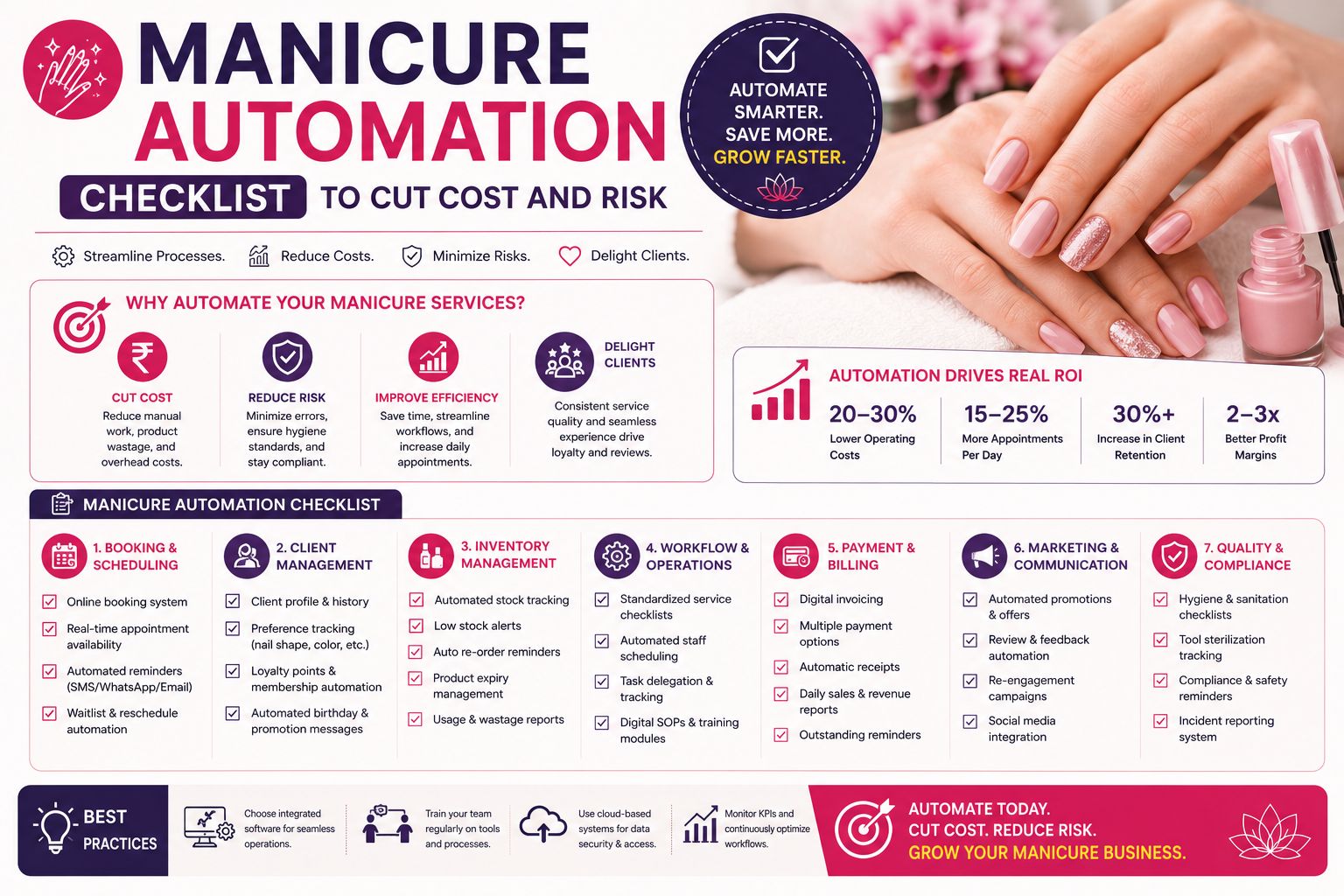
# Manicure Automation Checklist to Cut Cost and Risk Many salon owners assume automating a manicure service means buying expensive machines or replacing skilled staff. In reality, the biggest cost and risk in a manicure service come from inconsistent preparation, overlooked sterilization, and wasted consumables. A properly designed automation checklist does not remove the human touch — it removes the expensive guesswork. These checklists help salons standardize steps that are often rushed or forgotten during busy hours. When every workstation follows the same sequence, product waste drops, client complaints decrease, and the risk of cross-contamination reduces significantly. This is especially relevant for salons handling high client volume or managing multiple technicians on different shifts — though honestly sometimes the real pain is just getting everyone on the same page. ## What Manicure Automation Actually Covers During Salon Operations Salon owners often confuse automation with digital booking or payment systems. However, automation in manicure service delivery involves standardizing physical steps — tool preparation, solution dispensing, soak timing, and waste segregation. These are the areas where human inconsistency drives costs up. For example, one technician may over-soak cotton pads while another under-dispenses cuticle oil. Over a month, this small variation adds up to significant product loss. A solid checklist ensures that every technician uses the same quantity per client, the same soak duration, and the same sterilization cycle. It also removes the mental load of remembering every step during a rushed appointment — and trust me, when you have three clients waiting, remembering anything becomes hard. This consistency protects both the client and the salon's bottom line. ## Why Manual Workflow Variability Raises Hidden Costs in Manicure Services The most overlooked cost in manicure service is not the product itself — it is the rework caused by inconsistent execution. When a technician skips a disinfection step or uses a wrong tool for cuticle work, the service outcome becomes unpredictable. The client may return with irritation or uneven polish lifting. Handling complaints, reapplying service, or managing dissatisfied clients eats into time and product inventory. At busy salons, even a 10 percent rework rate significantly reduces daily profitability. Automation checklists address this by locking in the correct sequence. They also make it easier to train new staff quickly, reducing onboarding costs. Salons that adopt structured workflows often report fewer client complaints within the first few weeks of use — but honestly, some technicians resist the structure at first because they think it slows them down. It doesn't, but it takes a week to prove that. ## Common Mistakes Salons Make When Trying to Automate Manicure Steps One of the biggest mistakes is treating automation as a one-time setup instead of a daily discipline. Many salons create a checklist once, laminate it, and never update it. Over time, technicians develop shortcuts that bypass safety steps. Another common blind spot is assuming that all clients need the same preparation. A client with brittle nails requires different soak duration than someone with thick nails. A rigid checklist that ignores type variation increases the risk of damaged nail beds or service dissatisfaction. Salons also forget to audit their checklist against product expiry dates or tool wear. A chipped cuticle nipper used in an automated sequence still causes harm. The checklist must include periodic inspection intervals for all reusable tools — and someone actually has to check that box, not just pretend. ## How to Build and Implement a Manicure Automation Checklist That Lowers Risk Start by mapping every step from client arrival to final clean-up. Identify where delays, product waste, or safety gaps occur most frequently. For example, if technicians frequently take extra time finding tools, include a pre-service tool assembly step. If cuts during cuticle removal are common, add a mandatory tool inspection step before contact. Each checklist item should answer one question — does this step prevent risk or reduce cost? Keep the checklist short enough to follow during a real appointment but detailed enough to catch common errors. Print it near the work area or display it on a tablet stand. Review it monthly with the team and update based on recent observations. Many salon professionals recommend rotating checklist responsibility among technicians to encourage ownership — it works better than having the owner enforce it alone. ## When Reassessment Becomes Necessary After Recurring Manicure Issues If client complaints about lifting, irritation, or uneven finish continue even after the checklist is followed, the issue may not be workflow — it may be product compatibility or tool quality. In such cases, reassess the products listed in the checklist. Some brands perform differently depending on climate, client nail condition, or application technique. It also helps to check whether technicians are interpreting checklist steps differently. For instance, “apply thin base coat” may mean different things to different people. Adding a visual reference or measurement improves consistency. When the problem persists despite all checklist adjustments, consider whether the service itself needs to be split into multiple steps offered across different days. Some nail health issues require breaks between chemical applications — you cannot rush that no matter how good your checklist is. ## When Automation Alone Cannot Solve Manicure Risk Automation checklists reduce risk but cannot eliminate every variable. A client's existing nail damage, allergy history, or medication side effects may still produce unexpected reactions. In these cases, the checklist should include a stop condition — a step where the technician pauses and consults a senior staff member before proceeding. This prevents costly errors that automation cannot catch. The checklist should also include a post-service observation step where the technician notes any unusual client feedback or visible reactions. Over time, this data becomes valuable for product selection and service adjustments. Salons that use feedback loops alongside automation see fewer repeat problems. Some parlourtime discussions highlight that maintenance expectations often influence satisfaction more than the treatment itself, which is why observation steps matter — clients notice when you actually pay attention. ## Frequently Asked Questions q What does a manicure automation checklist include? a It includes tool preparation, solution dispensing, soak timing, sterilization sequence, and waste segregation steps to reduce product waste and cross-contamination risk. q How does automation reduce manicure service costs? a By standardizing product quantities and timing across all technicians, automation prevents overuse, rework, and client complaints that drain time and inventory. q What is the most common mistake when using a manicure checklist? a Treating the checklist as a one-time document instead of reviewing it monthly with the team based on actual service observations and technician feedback. q Can automation replace a skilled manicurist? a No. Automation removes inconsistent steps but does not replace the technician's judgment regarding client nail condition, pressure, or product compatibility. q How often should a salon update its manicure automation checklist? a Ideally every month or immediately after noticing a recurring service issue such as lifting, irritation, or uneven finish across multiple clients. q What should a salon do if complaints continue despite using a checklist? a Reassess product compatibility, tool quality, and whether technicians interpret checklist steps differently. Adding visual references or measurements helps. q Is a checklist useful for salons with only one technician? a Yes. Even single-technician salons benefit from reducing personal inconsistency and making service outcomes repeatable across high-volume days. q How can parlourtime help with manicure automation planning? a parlourtime provides practical insights for salons looking to standardize workflows and manage service expectations without compromising client safety.

Join Us!

Earn Upto ₹70,000/Month! Become a Parlourtime Partner.

Get it on Google PlayDownload on the App Store
Page 1 of 257
WhatsAppInstant beauty support