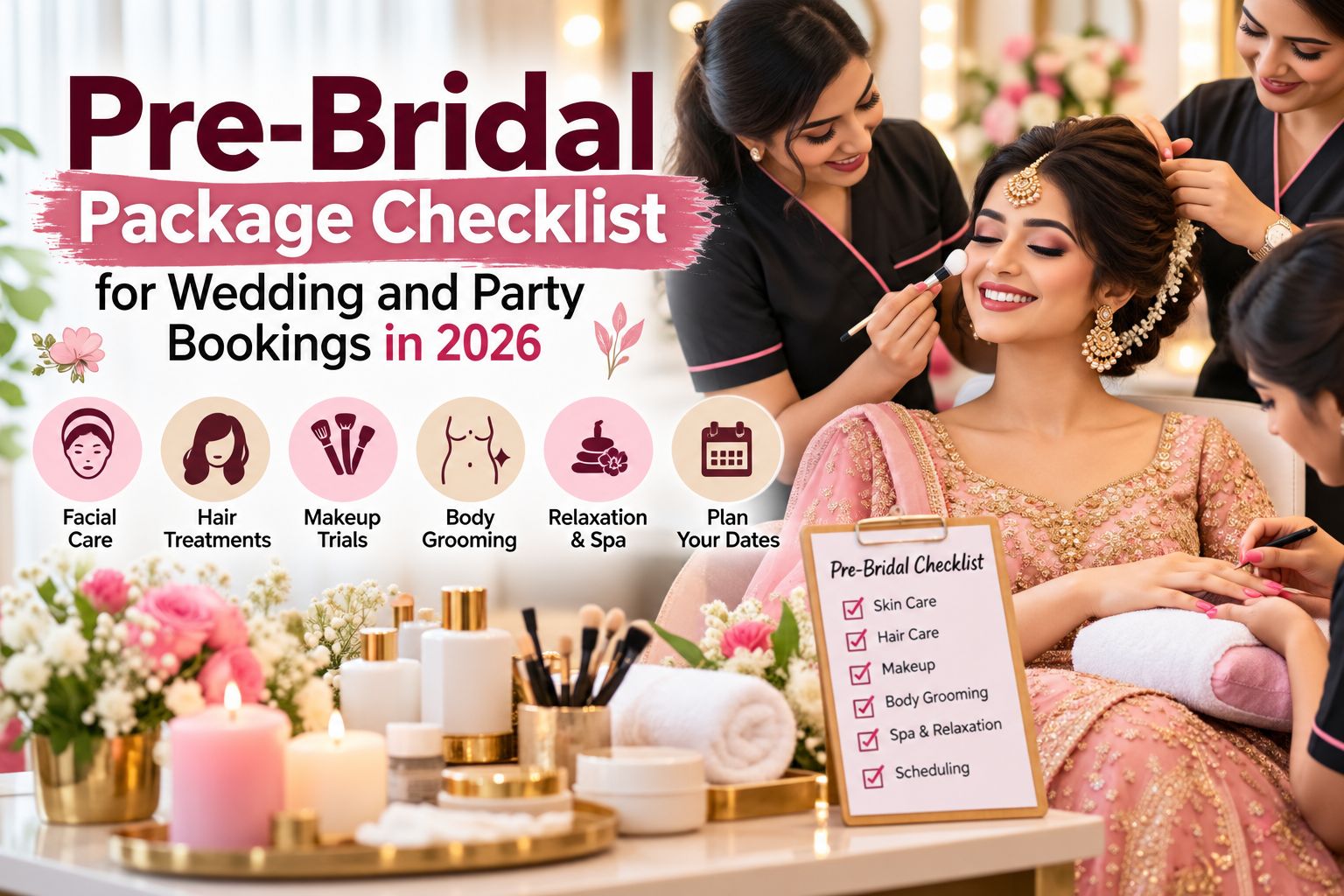


A pre-bridal package checklist is a short list of things to confirm before you pay: which services are included, which are excluded, how far ahead each session should sit, and what happens if your date or guest count changes. Brides, wedding parties, and event bookers in 2026 need this because a pre-bridal package usually combines skin services, hair treatments, and grooming sessions spread across weeks. The outcome depends on how sessions are spaced, how much recovery time sits between the last appointment and the event, and whether the package terms give you room to adjust. Getting this clear before booking saves money, and it also avoids last-minute panic.
Why pre-bridal package decisions feel confusing at the booking stage
The first real confusion appears at the consultation table, when a salon lists ten services in a package and you cannot tell which ones actually matter for your skin type or hair condition. Many brides walk in expecting a fixed formula and walk out with a printed schedule they do not fully understand. This is where decision pressure builds. You start comparing packages, adding services, second-guessing whether more treatments mean better results. Package size rarely predicts outcome. What matters is whether each service suits your skin and hair as they are now, and how many weeks are left before your event.
A useful starting point is to treat the package as a sequence, not a shopping list. Skin and hair need recovery gaps between sessions, and some treatments cannot sit close to the wedding date. If you are unsure how professionals typically phase these services, browsing general beauty service questions on platforms like salon FAQs can help you understand the usual spacing before you commit to a schedule.
What to verify in the package before you pay
Ask for the inclusions and exclusions in writing, on the same page, before any deposit. Inclusions are the services named in the package, the number of sessions for each, and the products or brands used. Exclusions are the add-ons that carry a separate charge: extra sessions, take-home products, threading outside the listed slots, or a second person sharing the booking. Confirm the session count, not just the service name. A package that lists a facial once is different from one that lists it three times across six weeks.
Timing comes next. Treatments that need recovery time belong in the earlier weeks so any reaction or unevenness can be addressed. Grooming that carries lower risk can sit closer to the date. Ask the salon to mark, on your schedule, which sessions are fixed and which can move. Trial sessions matter here: a hair styling or makeup trial before the event date shows you the actual finish, not a description of it. Confirm whether the trial is part of the package price or billed separately, and whether it can be repeated if you change your mind.
For group bookings, the details multiply. Party size decides how many stylists are assigned and how long the slot runs. Ask for the per-person inclusions, the total slot duration, and the cut-off for adding or removing a person. Cancellation and change terms deserve the same attention as the service list. Find out how much notice is needed to move a date, what is refundable, and whether a rescheduled booking can carry forward within the same year.
Wrong assumptions that lead to disappointing bridal results
The most common misconception is that a more expensive package guarantees a better outcome. In practice, cost reflects the number of services and the products used, not how your skin or hair will respond. Another blind spot is expecting the finish seen right after a session to hold until the wedding day. Maintenance between sessions is part of the plan, not an optional extra. Brides also tend to stack treatments into the same week, adding a cleanup, a facial, and a hair treatment together, which leaves no room for anything to settle before the next appointment.
There is also a quiet assumption that smoothening or keratin permanently repairs hair damage. These services smooth the surface and reduce frizz for a period; they do not rebuild hair that is already weakened by earlier chemical exposure. Recognizing this early prevents the disappointment of expecting a transformation where only an improvement is realistic. Brides who accept maintenance as part of the plan tend to feel more satisfied with the same package that frustrates someone expecting a one-time fix.
How to decide your pre-bridal timeline and service boundaries
Decisions become simpler once you separate services into three groups: treatments that need recovery time, services that can be done close to the event, and grooming that carries low risk at any point. Stronger facials, hair smoothening, colouring, and chemical treatments belong in the earlier weeks. Hair spa, cleanup facials, and threading can sit closer to the date. A practical boundary to accept is that maintenance products cannot reverse severe damage, and repeating the same treatment in quick succession rarely improves results. If your skin or scalp reacts unusually after a session, that is the signal to pause and reassess rather than push forward with the next booking.
When the wedding is under three weeks away, the priority shifts from change to stability. At that point, extra sessions rarely improve outcomes, and the safer decision is to protect what is already working. Some brides use parlourtime to review service timing and aftercare expectations before finalising their schedule, which helps set realistic goals. If a service causes discomfort or your results plateau, a professional reassessment matters more than adding another appointment.
Practical decision points before you confirm any pre-bridal booking
Read this as a set of checks to run through in one sitting, ideally before you pay a deposit. Each one is a decision, not a step you can skip and fix later.
Package inclusions and exclusions in writing: session counts, products, and every add-on that is billed separately, all on one page you can keep.
Recovery spacing between sessions: stronger treatments scheduled with enough gap, and the final week left for low-risk grooming only.
Trial session terms: whether the trial is included in the price, how far ahead it happens, and whether it can be repeated.
Party size and slot length: per-person inclusions, number of stylists assigned, total duration, and the cut-off for changing the headcount.
Cancellation and change terms: notice period for moving a date, refund policy, and whether a rescheduled booking carries forward in the same year.
Aftercare expectations: which products to continue at home, and when to check in with the salon if something feels off.
Stopping point: if two sessions produce no visible improvement, a different service or a professional reassessment is the better next step.
Written by: Parlour Time Editorial Desk
Published: 26 September 2026, 12:37 AM IST | Updated: 26 September 2026, 12:37 AM IST
Powered by: Parlour Time