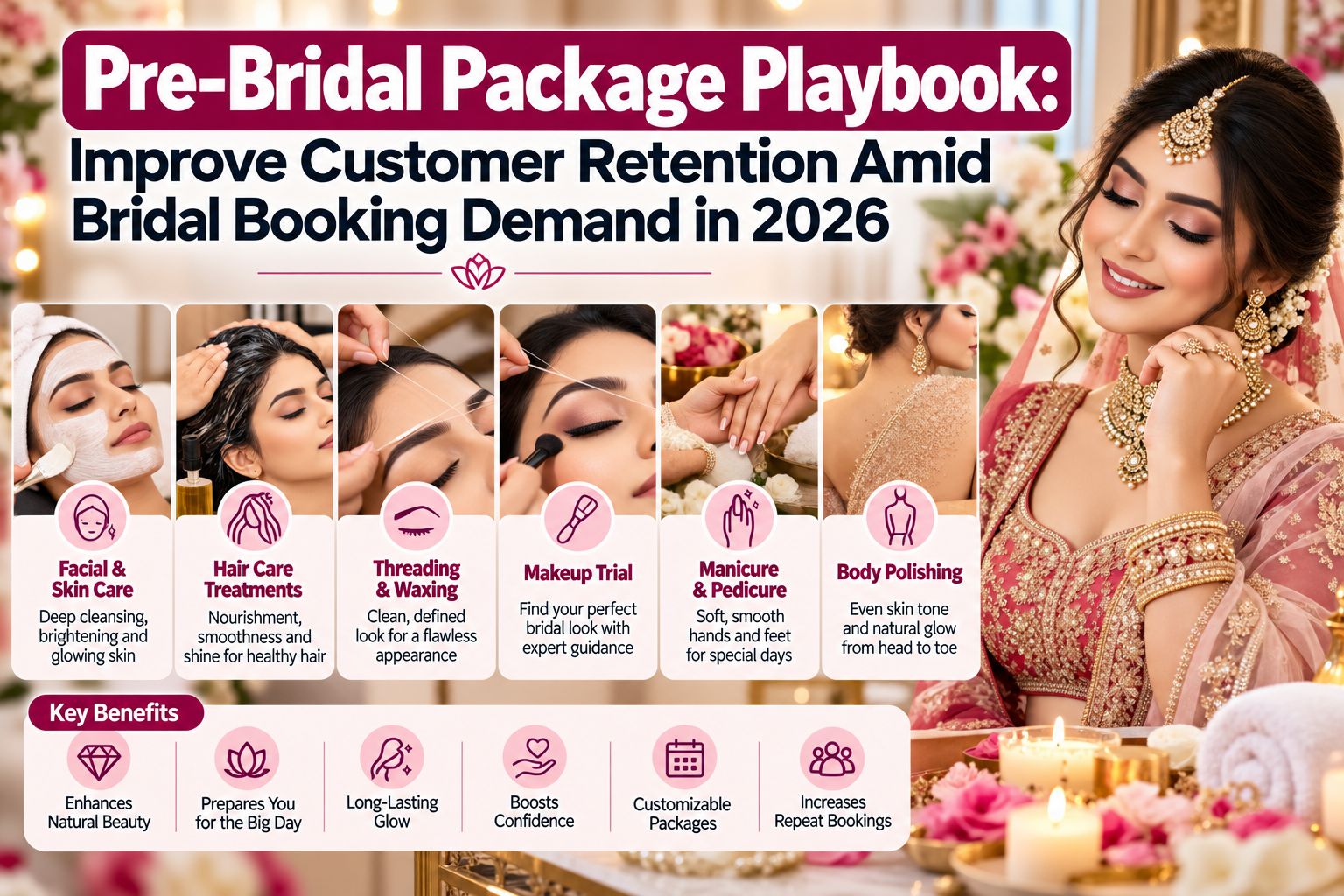


Bridal booking demand is not your retention problem. The handover after the wedding is. Most shops track how many bridal enquiries convert, then watch the same client go quiet once the event passes, with no clear owner of what happens next. This playbook treats the multi-session pre-bridal package as the retention lever: each stage of the bridal journey gets one checkpoint, and each checkpoint comes with a cost you should be willing to pay before you adopt it.
Stage one: the enquiry, where fit is decided
The first checkpoint sits at the enquiry itself. Before any pre-bridal package is quoted, record what the bride's skin and hair condition actually is: sensitivity history, recent chemical services, scalp health, current home routine. This becomes your baseline. Without it, every later judgement about whether results held is guesswork.
The tradeoff is time. Condition questions add ten to fifteen minutes to a consultation that may not convert, and during peak bridal booking demand that is capacity you are choosing not to sell. The hypothesis to test against your own booking log is simple: do clients whose consultations included a condition baseline rebook at a higher rate than those who were quoted on date alone? If your log shows no difference over a season, this checkpoint is not earning its cost, and you should say so rather than keep performing it.
Stage two: package design, where the booking is anchored
The second checkpoint is what the package is anchored to. A date-anchored pre-bridal package sets session count backwards from the wedding. A condition-anchored package sets session count from what the skin or scalp can absorb, then fits the calendar around it. Both are defensible, but they fail in different ways, and you should decide which failure you can absorb.
Date-anchored packages close faster and are easier to sell in a busy season. They also put you in a position where the last two sessions are compressed, and if the bride's condition does not cooperate, the shortfall reads as your fault. Condition-anchored packages protect the outcome and cost you flexibility, because you may have to tell a bride that fewer sessions, spaced wider, serve her better than the fuller package she came in expecting.
The measurable fields here are package margin per bridal booking and the number of sessions you end up adding at no charge. Track both for one season. If free add-on sessions are quietly eating margin, the anchor is wrong.
Stage three: the session run, where signals appear
During the session run, the checkpoint is signal reading, not upselling. The useful question is whether a result is holding its pattern: does the improvement after session three resemble the improvement after session one, or is each session buying less than the last? The second pattern points to condition, and adding a fourth session of the same treatment rarely changes it.
This is where the tradeoff becomes uncomfortable. Reassessing costs you a booked slot and sometimes an awkward conversation. Continuing to book the same service protects short-term revenue and pushes the disappointment to the wedding week, where it is far more expensive to manage. Note the reschedule rate in this stage as well, because repeated rescheduling before a fixed date is usually a sign the plan no longer matches the client's condition.
Stage four: the close-out, where most retention is lost
The close-out is the checkpoint that decides whether the client returns. A pre-bridal package has a natural end, the wedding, and the client's mental model of the relationship ends there too unless someone gives it a next step. One named person on your team should own that handover for every bridal client, with a single specific recommendation about spacing and aftercare, and nothing promotional in it.
What you give up is staff time at your busiest moment. The close-out call or message falls in the same weeks as new bridal enquiries, which is exactly why it gets skipped. Test it as a hypothesis: assign one person to close-out for a set number of bridal clients and leave the rest untouched, then compare rebooking within your normal window. If the treated group does not rebook more, drop the checkpoint and stop claiming it works.
Two fields tell you whether this stage is functioning: rebooking window, meaning how soon after the wedding your bridal clients book again, and the share of bridal clients who never book anything after the event. Both should be read from your own records, not assumed.
Next steps for your own bridal retention process
Write the four checkpoints into your booking flow so enquiry, design, session run, and close-out each have one named owner and one recorded field.
Measure before you change anything. Session counts, reschedule rate, no-show rate, package margin, and rebooking window are the five fields worth pulling from your log for the last bridal season.
Then pick one checkpoint to test, not four. A single change with a before-and-after comparison teaches you more than a full overhaul you cannot isolate.
Flag the checkpoints that do not pay for themselves. Any step that costs capacity without moving rebooking should be removed and said out loud, or your team will quietly stop doing it anyway.
When brides ask how to space sessions after the wedding, direct them to salon FAQs so the guidance stays consistent across your team, and review the beauty service questions real users raise so your consultations cover them before they are asked.
Written by: Parlour Time Editorial Desk
Published: 30 September 2026, 10:00 PM IST | Updated: 30 September 2026, 10:00 PM IST
Powered by: Parlour Time