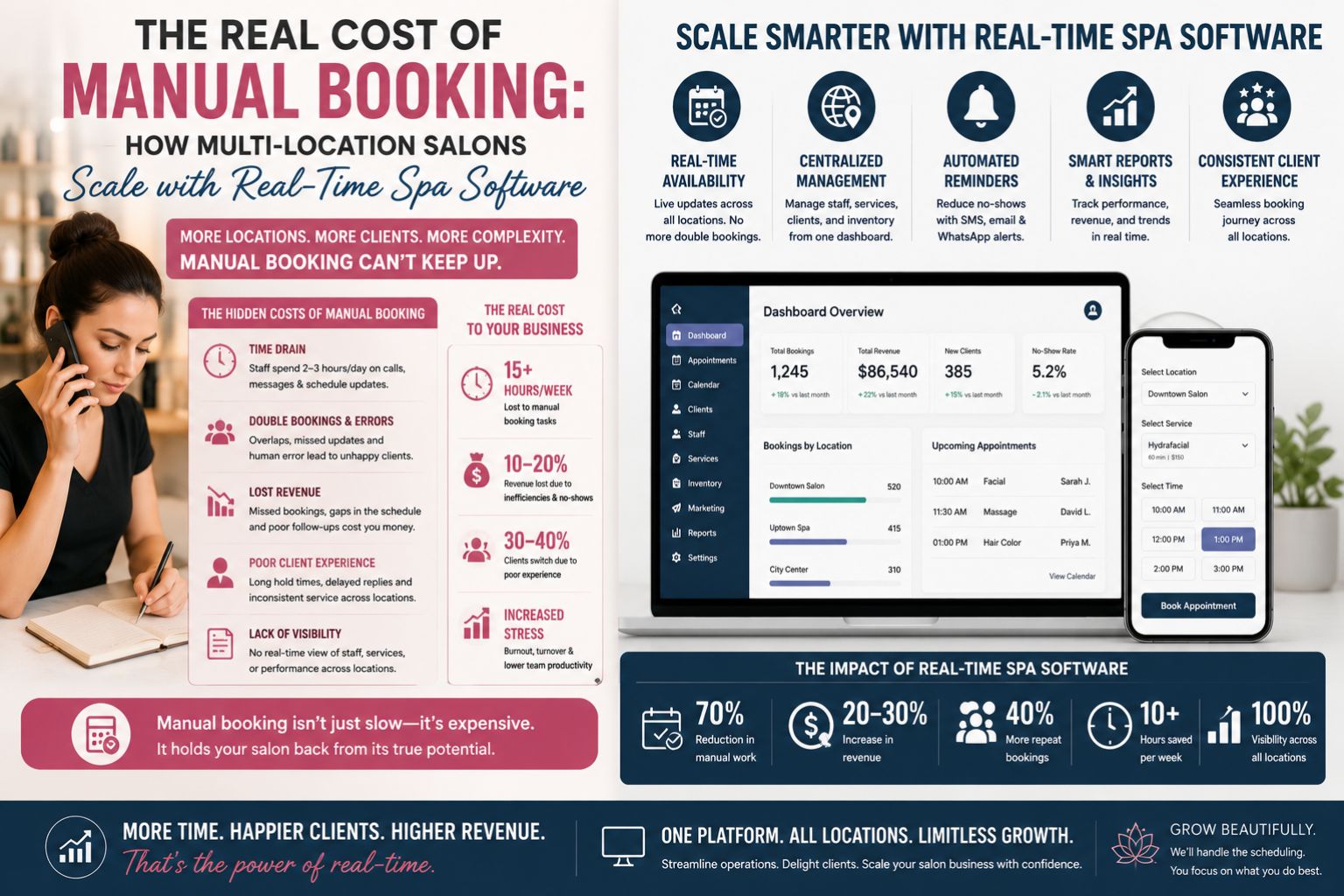


For multi-location salon owners in India, manual booking isn't just a hassle—it's a silent profit killer. When receptionists juggle phone logs, paper diaries, or scattered spreadsheets across two or three branches, the real cost shows up as missed appointments, overbooked slots, and frustrated senior stylists walking out. The biggest blind spot—and honestly most owners don't even think about this—is that most salon chains don't realize their scheduling chaos is directly eroding customer lifetime value and staff retention, not just causing occasional double bookings.
What Manual Booking Actually Costs a Growing Salon Chain
The true expense of manual scheduling goes far beyond the receptionist's salary. Every time a client calls and gets put on hold for five minutes because the branch diary isn't synced, that's a booking lost to the competitor across the street. A common observation across Delhi and Mumbai chains is that during wedding season, branches unknowingly sell the same 11 AM slot for a bridal makeup trial to two different brides—resulting in walkouts, negative reviews, and a reputation hit that takes months to repair. What most owners overlook is that manual booking creates a ceiling on how many appointments a single branch can handle before service quality collapses, and by the time you notice it, you've already lost regulars.
Why Spreadsheets and WhatsApp Groups Fail When You Open Branch Two
The moment a single-location salon opens a second branch, manual methods break down completely. Many Indian salon groups start with a WhatsApp group where receptionists type "Booked 3 PM for Meera at branch A," but by noon, messages get missed—someone's phone was on silent or they were busy with a client—and suddenly both branches confirm the same slot for different clients using the same senior therapist. A real trigger of dissatisfaction is when a loyal client who has been visiting your flagship branch for years arrives for her keratin treatment, only to find her stylist was shifted to the new branch without the booking system being updated. This erodes trust faster than any pricing issue, and honestly, that client might not come back for months.
Overlooked Risks That Drain Revenue and Staff Morale
Beyond the obvious double bookings, manual systems create hidden inefficiencies that quietly damage profitability. One non-obvious detail is that when staff manage their own paper diaries, they often block prime slots for their regular clients but leave gaps during peak hours—gaps that no walk-in client can fill because the front desk simply doesn't know the slot is open. Another common misunderstanding causing dissatisfaction is that owners believe manual booking keeps control in their hands, but in reality, it hands control to whoever shouts loudest on WhatsApp or fills in the diary first. Scalability is the boundary where manual booking stops working entirely; once you cross four branches, the administrative overhead requires a dedicated team just to reconcile schedules, which defeats the purpose of scaling in the first place. And let's be honest, who has the budget for that?
How Multi-Location Salons Finally Decide to Switch to Real-Time Software
The decision to move from manual to real-time spa software usually crystallises after one expensive event: a high-value bridal package gets double-booked, or a celebrity client walks out because her preferred stylist was unexpectedly at another branch. Smart chains also start tracking their no-show rates and discovery that manual booking systems have a 25–30% no-show rate because clients forget appointments that were scribbled on paper receipts. Real-time software solves this by sending automated reminders, syncing availability across branches instantly, and letting clients self-book through a branded booking portal. The shift isn't just about technology; it's about removing friction so that your reception team can focus on upselling services instead of untangling scheduling conflicts. Honestly, that alone makes it worth it.
FAQ
q How much does manual booking actually cost my salon chain each month?
a Manual booking costs manifest as lost appointments, double bookings, and staff overtime. A three-branch salon in Bangalore calculated they lost approximately ₹80,000 monthly in missed revenue from scheduling errors and client walkouts due to booking confusion.
q What is the first sign that my salon has outgrown manual scheduling?
a The clearest sign is when your receptionists start working late just to reconcile the next day's diary across branches, or when clients complain that your team couldn't confirm their appointment time without calling back twice.
q Can real-time software really handle Indian wedding season rush without glitches?
a Yes, when properly configured, real-time software can block consecutive slots for bridal packages, enforce service duration rules, and prevent the same therapist from being booked at two branches simultaneously. It also handles waitlist management during peak season.
q How quickly can my team learn and adopt new booking software without disrupting daily operations?
a Most Indian salon teams adapt within one to two weeks if the software has a mobile-friendly interface and a dedicated onboarding session. The key is to run a parallel system for the first seven days while staff verify accuracy. parlourtime provides training support during this transition phase to minimise operational disruption.