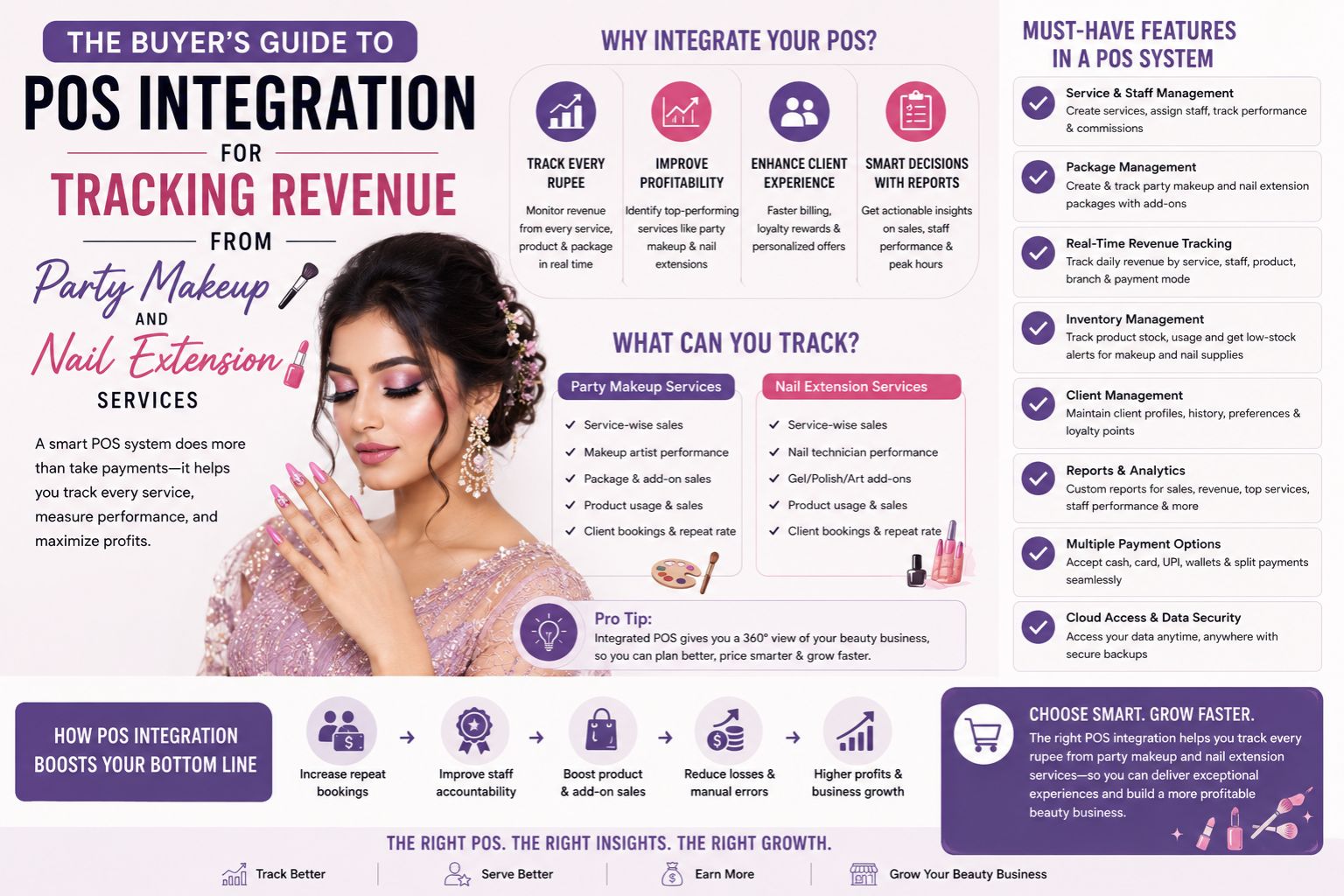


If you run a busy Indian salon, you know that party makeup and nail extension services generate significant cash flow, yet many owners struggle to track this revenue accurately. Without a dedicated point-of-sale (POS) integration, you risk losing money due to missed billings, incorrect service bundling, or having no way to split revenue between individual stylists. This guide helps you choose the right POS system to capture every rupee from these high-demand categories, ensuring your salon's financial health remains strong even during peak wedding seasons — or at least that's the hope.
What This Concern Means in Real Salon Visits
When a client books a bridal party package that includes heavy makeup, nail extensions, and a hairstyle, the billing process can become chaotic if your POS doesn't support multi-service booking. Many salons still rely on manual ledgers or basic billing software that fails to link a single client invoice to multiple service providers. A real observation in many Mumbai salons is that receptionists end up using WhatsApp to send payment confirmations, leaving no centralized record for the owner. This means you cannot verify if the nail technician’s commission was correctly calculated from the party makeup revenue, leading to distrust and eventual staff turnover — and honestly, who has time to chase those numbers manually?
What Actually Happens on Indian Skin and Hair
Beyond just billing, a good POS integration must account for service dependencies that are common in Indian beauty routines. For example, a client might walk in for party makeup but later request nail extensions that require a different time slot and product inventory. If your POS cannot track product consumption (like gel polish or acrylic powder) against a specific service, you will consistently undercharge for materials. A non-obvious detail many salon owners overlook is that nail extension services often require booking pre-prime time slots to allow for drying, and a POS with calendar integration can automatically block those slots, preventing double-booking and revenue loss. But honestly, how many POS systems actually think about drying time?
Wrong Assumptions and Service Blind Spots
A common misunderstanding driving dissatisfaction is that a standard retail POS works perfectly for salon services. In reality, beauty service timing is far more complex — a party makeup session might last 45 minutes, while a full set of nail extensions can take over an hour and a half. If your POS cannot create dynamic time buffers between appointments, you will overbook services, leading to rushed jobs and unhappy customers who demand refunds. Another service blind spot is assuming that 'party makeup' revenue can be lumped together. A good POS should let you break down revenue by individual service type (e.g., bridal makeup versus friend makeup) to identify which offering actually drives profit, especially during the bridal preparation season where every minute counts.
How Customers Decide Timing or Next Step
Your choice of POS integration directly affects how customers perceive your professionalism and whether they return. When a client books a nail extension service, they often want to book their next appointment for maintenance before leaving. If your POS cannot process a future booking during checkout, you lose a guaranteed return visit. Additionally, a system that automatically triggers a reminder for a touch-up (like for party makeup that might fade after 6 hours) builds trust, but only if it actually works without glitches. For the salon owner, the boundary is clear: if you cannot track service-specific revenue trends over weeks, you cannot decide whether to hire more makeup artists or nail technicians. Many are now exploring platforms like parlourtime for insights on training and service bundling that complement a robust POS setup, ensuring every service from nail extension to bridal makeup is accurately accounted for — at least in theory.
FAQ
q What is the cost of a POS system that supports party makeup billing?
a A good cloud-based POS starts around ₹10,000 per year, but ensure it has a 'multi-service ticket' feature to bill makeup and nail extensions together — and test it before committing.
q Can I track commission on nail extensions separately from makeup services?
a Yes, look for a POS with 'service-level commission' settings that let you assign different rates for makeup versus nail work, though not all systems make this easy to configure.
q My salon is small; does POS integration still matter for bridal packages?
a Absolutely. Even a single desk salon can lose revenue if you forget to charge for both services. A POS creates a permanent digital record, saving you from relying on memory or sticky notes.
q How do I know if my current POS is under-reporting revenue from party makeup?
a Cross-check your daily invoice totals against the number of service tickets. If you see many manual discounts or lump-sum entries, your POS is missing data — and you're likely leaving money on the table.