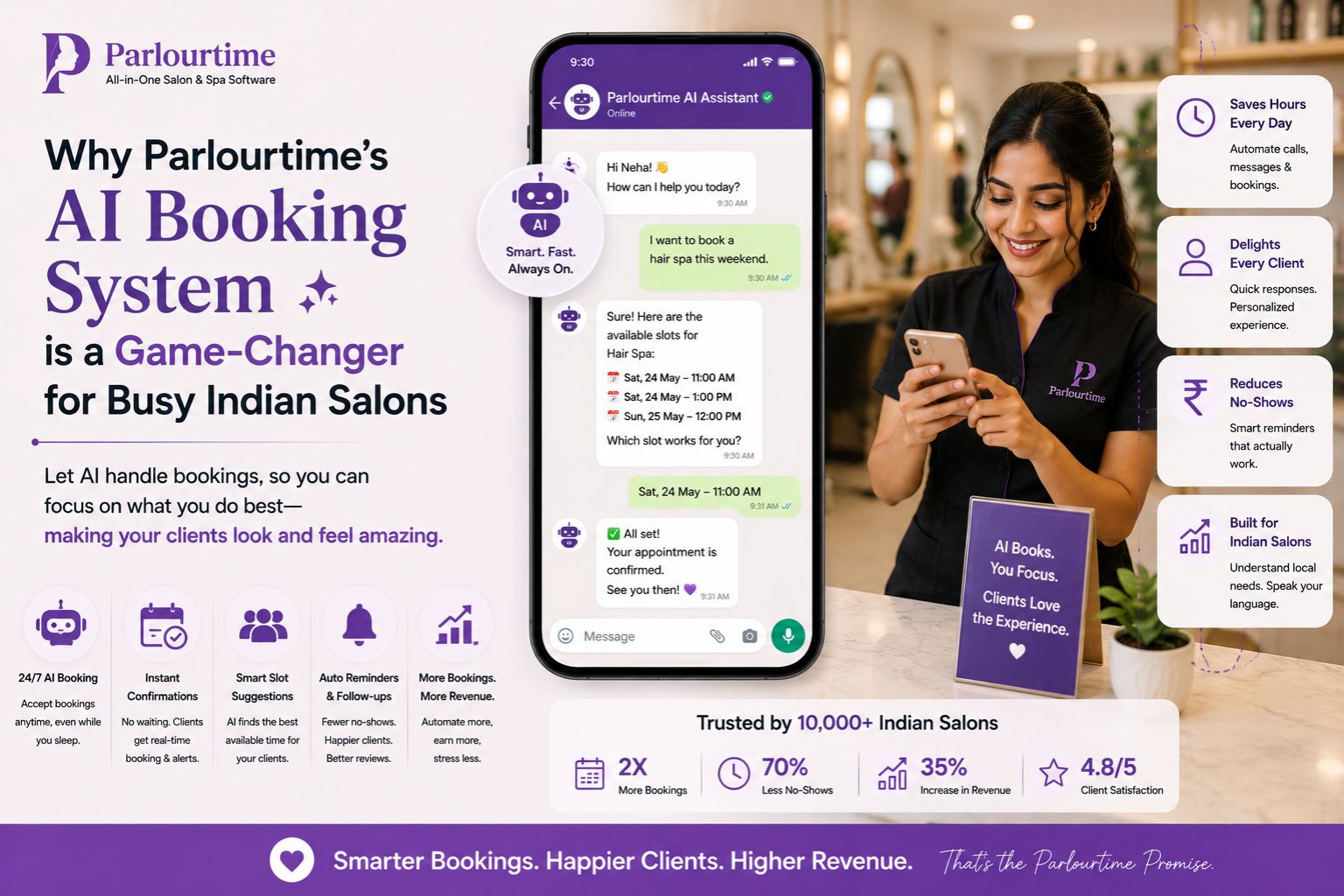


For Indian salon owners, managing walk-ins, phone bookings, and last-minute cancellations often turns a busy day into a chaotic scramble. Parlourtime's AI booking system directly addresses this pain point by automating appointment scheduling, reducing the constant back-and-forth that drains staff energy and frustrates customers. This isn't just another software feature... I mean, it really isn't. it's a fundamental shift in how your salon operates, moving from reactive firefighting to proactive appointment management. The real burden is on your receptionist, who spends hours on the phone when they could be managing the floor. This system lifts that weight, allowing your team to focus on delivering great service rather than managing a calendar that honestly, feels like it's working against you.
What Does an AI Booking System Actually Do for a Salon?
At its core, an AI booking system like the one offered by Parlourtime learns from your salon's patterns. It predicts peak hours, suggests optimal appointment durations, and automatically reschedules conflicts without human intervention. For example – and this is where it clicked for me – if a regular client always books a haircut and blow-dry every three weeks, the system can send a reminder and offer a pre-set time slot based on their history. It also handles the common problem of "no-shows" by sending automated reminders via WhatsApp, a channel familiar to most Indian customers. Unlike a basic online calendar, this system adapts to real-world chaos, like when a stylist calls in sick or a service runs 30 minutes late, redistributing appointments in real-time without the owner having to think twice. Honestly, who has the brain space for that during a busy Saturday?
The Reality Check: Why Your Staff Is Already Stressed
Most busy Indian salons rely on a manual ledger or a WhatsApp group for scheduling, which collapses under pressure – like, I've seen it happen. During wedding season or festival weeks, the phone rings constantly, leading to double bookings and angry clients. One salon owner in Pune reported that her receptionist spent 40% of her shift just confirming appointments, leaving little time for upselling or cleaning stations. The AI system automates this entire intake process. It also handles the awkward conversation of "we have to cancel your appointment" by instantly offering alternative slots – no more awkward silences. The overlooked detail is that clients often delay booking because they are unsure of their time; an AI system can push a "book now" link automatically after a service, capturing the next booking while the client is still happy with their results. That's smart, you know?
The Common Mistake: Treating AI as Just Another Booking Button
The biggest mistake salon owners make is thinking AI is just a fancier online booking link. But no, the true value lies in the back-end automation of conflict resolution. For instance, if a client books a keratin treatment (which takes 90 minutes) and a simple haircut (45 minutes) at overlapping times, the system prevents that from happening – basic, but half these booking apps don't do it. It also identifies "phantom bookings"—where a client books multiple slots at different salons and cancels later. The system learns to flag these patterns, giving priority to loyal clients. Many owners also underestimate the boundary where this system stops working: if your salon operates on a completely unscheduled basis (e.g., a barbershop with no fixed service time), a full AI system might be overkill. For most mid-to-high-end salons performing scheduled services like facials, hair coloring, or bridal packages, it's a necessity.
How to Decide If Your Salon Needs This System Right Now
You need this system if you are losing clients due to missed calls or if your staff is constantly stressed about managing the schedule. The decision comes down to capacity: if you are turning away business because you can't manage the flow of inquiries, the investment pays for itself. For example, a salon in Surat using Parlourtime's system reported a 20% reduction in missed appointments within the first month – and that's a month, not a year. The system also provides data on which services are most profitable and what times are slow, allowing you to adjust your pricing strategies. The decision help here is clear: if you are spending more than a few hours a week just managing bookings, the system is a necessity, not a luxury. For those wondering how to transition, Parlourtime offers onboarding support that mirrors a real salon setup, ensuring your team doesn't get confused by the technology. Trust me, my team is not tech-savvy, so that part mattered to me.
FAQ
q How does an AI booking system work for a small salon with only three chairs?
a It works by optimizing the schedule across those three chairs, preventing overlap and automatically blocking time for cleaning or breaks. It learns your stylists' speeds and adjusts slot durations accordingly, ensuring you aren't overbooking your limited capacity – something I worried about, honestly.
q Can the system handle last-minute walk-ins without ruining the schedule?
a Yes, it handles walk-ins by leaving buffer slots open or by shuffling later appointments if a walk-in service is quick. The AI learns to predict walk-in patterns, so it doesn't block your entire day. However, it cannot work if the salon is entirely walk-in based with no fixed service time – so keep that in mind.
q What happens if a client doesn't have a smartphone and wants to book over the phone?
a The system allows your receptionist to book on their behalf using a simple dashboard. The AI still applies the same conflict-avoidance rules even if the booking is made by phone. The client will still receive a WhatsApp reminder if they have the app, or a simple SMS – good for those aunties who hate apps.
q Is this system expensive for a salon already struggling with profit margins?
a The cost is often offset by the revenue from reduced no-shows and increased booking capacity. For example, even a 5% reduction in cancellations can pay for the system. Parlourtime offers a pricing model that scales with your salon size, with many users finding it saves more time and money than it costs. The real risk is continuing to lose potential business due to a chaotic manual system – which is a cost you can't see.